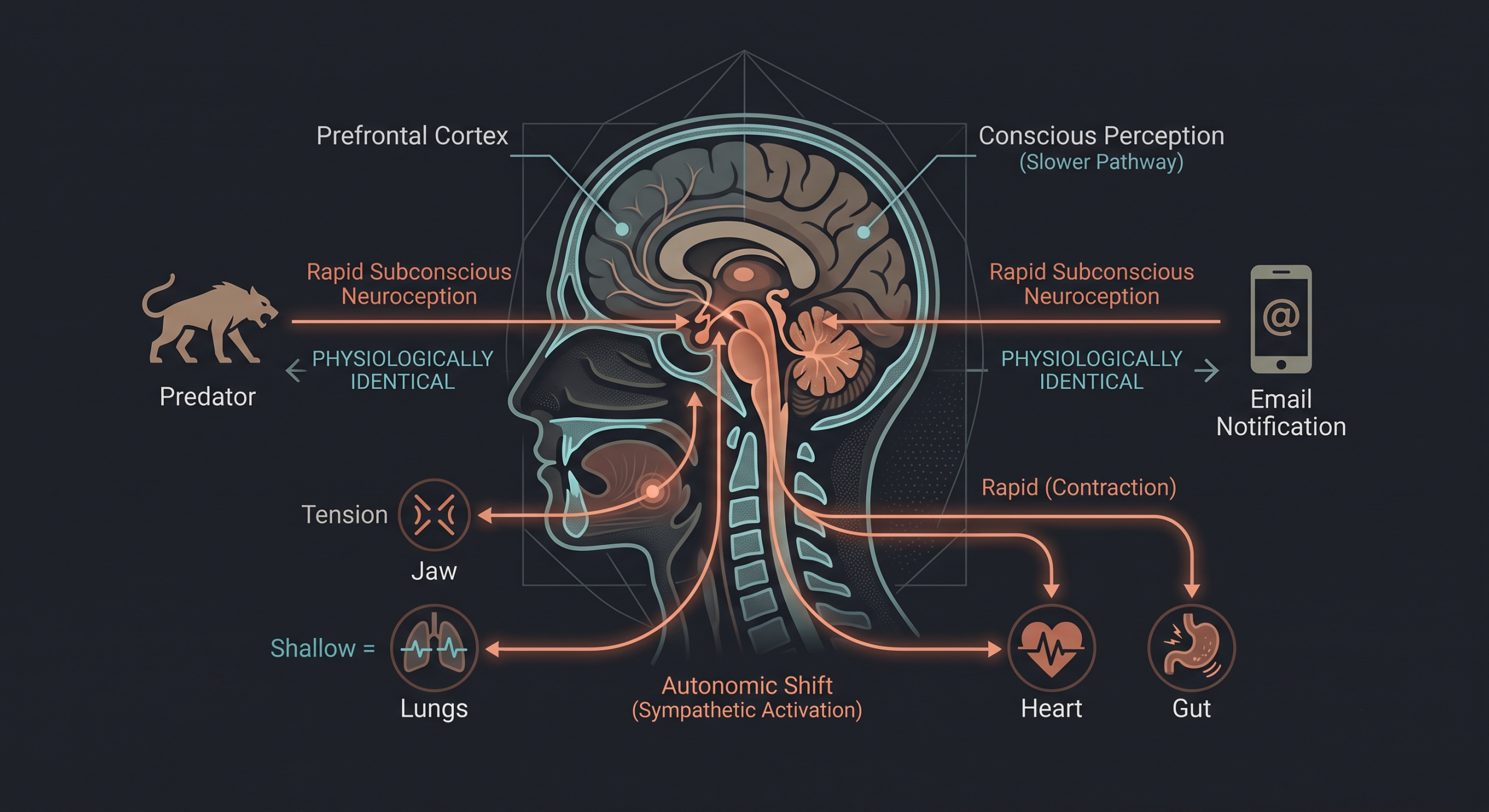
Have you ever wondered why a simple calendar notification or an unread message from a colleague can cause an immediate spike in your heart rate? The answer lies in a biological mechanism called neuroception, a term coined by Dr Stephen Porges to describe the nervous system’s continuous, subconscious scanning of the environment for cues of safety or threat.
The System Beneath Your Thinking
Unlike perception, which involves conscious thought, neuroception is not logical and does not evaluate objective evidence. Instead, it responds instantaneously to subtle, non-verbal signals, such as a shift in a colleague’s tone of voice, microscopic facial muscle tension, postural cues, environmental sounds, or even your own internal body sensations. This all happens before your prefrontal cortex has processed a single word.
Because this system operates entirely below conscious awareness and faster than conscious thought, your body responds to a threat before your mind has even formed an opinion about it. By the time you consciously register that an email feels like an attack, your jaw has already tightened, your breathing has shifted into your chest, your heart rate has risen, and your gut has contracted.
Chronic Stress and “False Alarms”
In a well-regulated nervous system, neuroception is exquisitely accurate, picking up genuine threat cues and releasing them when the environment returns to safety. However, for chronically stressed professionals operating under high allostatic load, this system becomes severely recalibrated.
Prolonged exposure to stress pushes the nervous system into what is known as “compelling survival physiology,” where it becomes asymmetrically tuned to threat perception and largely ignores cues of safety. Because the system’s baseline has shifted, it begins to generate physiological “false alarms” to neutral professional stimuli. The nervous system is retrained to treat objectively safe environments, approaching deadlines, or routine interpersonal interactions as acute dangers. Ultimately, the biological machinery designed to keep you alive cannot distinguish between a predator on the savanna and a passive-aggressive message from a board member.
Why You Can’t “Think” Your Way Out
This physiological recalibration explains why you can intellectually know that a situation is safe, yet still feel physically panicked. Cognitive approaches like rational analysis or positive reframing often fall short because they operate in the prefrontal cortex, which receives information only after the neuroceptive system has already processed the threat and initiated a survival response. You cannot simply think your way past a system that operates before thinking begins.
Recognising these false alarms not as irrational psychological flaws, but as the predictable, biological outputs of a finely tuned system under extraordinary load, is the essential first step toward recalibrating your nervous system back to safety.
iuan & iuan Academy provides educational resources and performance coaching, not medical services or clinical treatment.
© 2026 iuan · iuan Academy | iuan.com.au