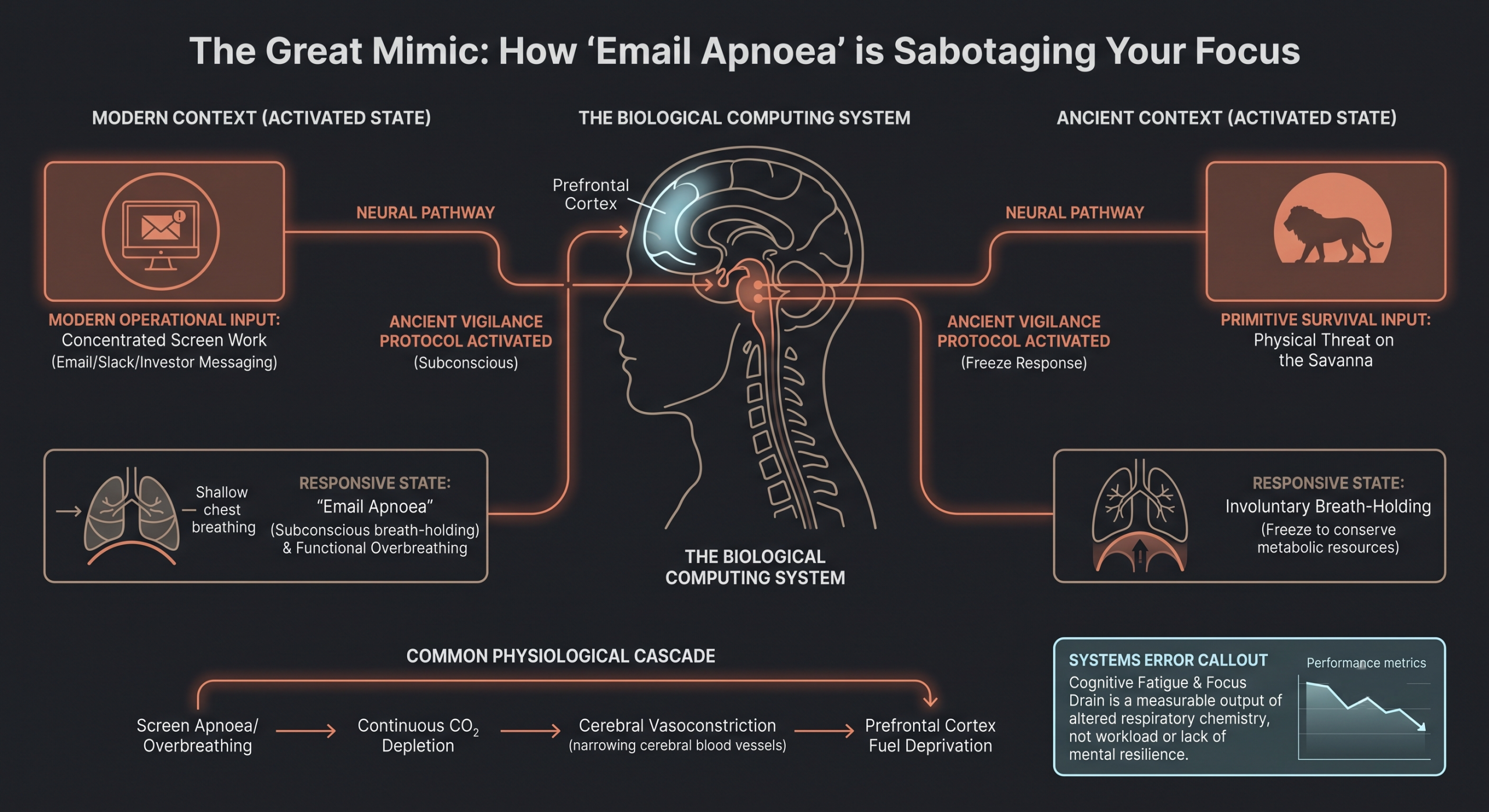
Many high-performing professionals attribute their persistent brain fog, afternoon energy crashes, and difficulty concentrating to high workloads or a lack of mental resilience. However, there is a distinct, overlooked biochemical mechanism actively sustaining these symptoms. Your cognitive fatigue may not be a psychological failure, but a functional overbreathing pattern running quietly in the background of your workday.
Habitual overbreathing is one of the most under-acknowledged physiological drivers of chronic stress symptoms in executives. Under sustained pressure, the nervous system defaults to shallow, rapid, chest-dominant breathing. This altered breathing pattern is frequently referred to as “the great mimic” because its downstream somatic consequences, such as dizziness, chest tightness, palpitations, gut disturbances, and chronic fatigue, closely resemble cardiac, neurological, or gastrointestinal conditions. Consequently, professionals are often run through exhaustive medical investigations for years without finding a clear organic cause.
The Subconscious Trap of “Email Apnoea”
One of the most insidious triggers of this biochemical disruption during concentrated cognitive work is “email apnoea” (or screen apnoea). When you reply to emails, process complex tasks, or wait for an anticipated notification to load, you likely hold your breath or slip into a highly irregular respiratory rhythm without realising it.
This subconscious breath-holding is a primitive mammalian defence mechanism. Your body holds still to conserve metabolic resources and maintain vigilance, behaving exactly as it would when sensing a predator in the wild. The profound issue is that your nervous system cannot distinguish between a physical threat on the savanna and an incoming Slack notification or investor email. When you repeatedly hold your breath or gasp at your screen, you drive a continuous, hidden depletion of carbon dioxide CO2 in your blood.
The 25% Rule: How Hypocapnia Starves the Brain
Carbon dioxide is not merely a waste product of metabolism; it is a critical regulatory molecule that controls smooth muscle tone throughout your blood vessels and dictates how much fuel reaches your brain.
When habitual overbreathing or screen apnoea chronically depletes your CO2 levels, it produces a state of subclinical hypocapnia and respiratory alkalosis. Because CO2 is the primary chemical lever regulating cerebral blood flow, a drop in CO2 causes immediate cerebral vasoconstriction, narrowing the blood vessels in the brain.
The clinical reality is stark: a 25% reduction in arterial CO2 produces approximately a 25% reduction in cerebral blood flow.
By overbreathing or holding your breath, you systematically starve your prefrontal cortex of oxygenated blood. Since this brain region is the seat of strategic reasoning, complex decision-making, and emotional regulation, you are left operating with genuinely impaired cognitive capacity. The resulting brain fog, decision fatigue, and low-grade anxiety are the direct products of your altered respiratory chemistry, not your workload.
Nasal vs. Mouth Breathing: The Vasodilatory Difference
The most immediate physiological defence against this cognitive drain is to consciously establish exclusive nasal diaphragmatic breathing.
Your nasal passages are sophisticated structures designed specifically for respiration. Nasal breathing produces nitric oxide in the paranasal sinuses, a potent vasodilatory compound that improves oxygen delivery to your tissues by approximately 10% to 15% while reducing airway resistance. Furthermore, breathing through your nose naturally slows your respiratory rate, warms the incoming air, and facilitates diaphragmatic engagement.
Conversely, mouth breathing bypasses these regulatory functions. It encourages rapid, shallow, chest-dominant breathing that recruits accessory neck and shoulder muscles, further accelerating CO2 depletion and maintaining neural hyperexcitability and sympathetic dominance.
By reclaiming nasal diaphragmatic breathing as your default office state, you restore proper CO2 balance, release the constriction on your cerebral blood vessels, and unlock your brain’s full strategic capacity.
iuan & iuan Academy provides educational resources and performance coaching, not medical services or clinical treatment.
© 2026 iuan · iuan Academy | iuan.com.au