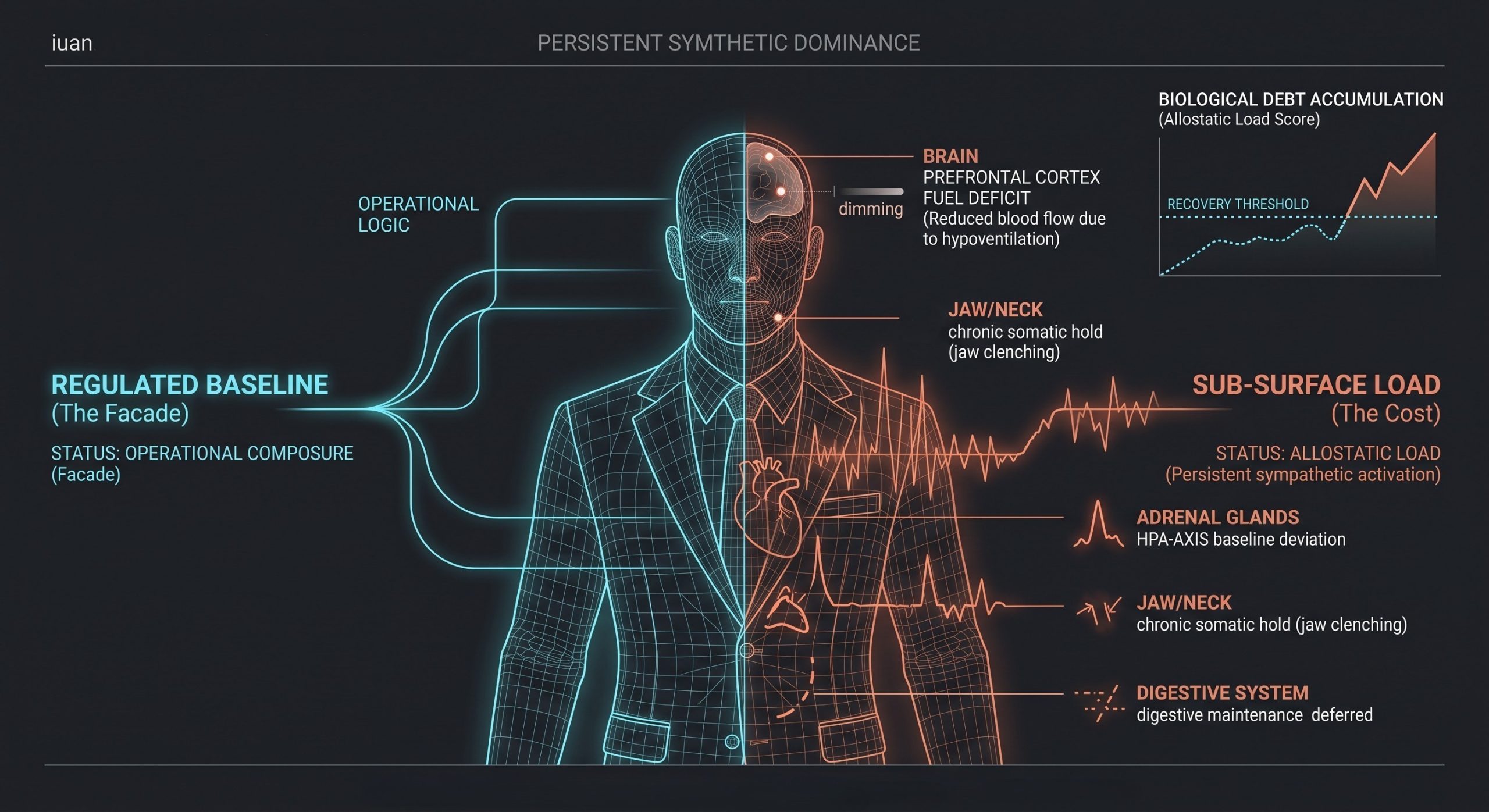
High-performing professionals are exceptionally skilled at one particular thing: appearing regulated when they are not. Years of professional conditioning and leadership expectations demand composure during stressful events, forcing individuals to hold still, maintain control, and suppress visible emotional or physical responses.
While this composure has short-term utility in the boardroom, it carries a severe and poorly understood biological cost.
The Biology of Incomplete Survival Cycles
When your neuroceptive system detects a threat, whether a tense board negotiation, public speaking, or a confrontation, the sympathetic nervous system mobilises survival resources. Stress hormones flood the bloodstream, heart rate accelerates, and muscles prime for action, generating what is described as incomplete action impulses.
In nature, this activation cycle completes automatically. An animal that escapes a predator will, within minutes of reaching safety, undergo a period of spontaneous discharge, shaking, trembling, shifting temperature, and taking deep sighs to dissipate the mobilised survival energy and return to baseline.
In professional environments, this completion cycle almost never occurs. The meeting ends, the difficult call finishes, and the executive moves immediately to the next task while maintaining perfect composure. The mobilised survival energy does not simply dissipate; it is stored in the body as chronic muscular tension, elevated baseline arousal, and compounding allostatic load. Over time, hundreds of these incomplete cycles compound, driving the chronic fatigue, jaw tension, and emotional blunting characterised as burnout.
Two Principles for Working with Activation
To process physiological arousal rather than override it, the somatic experiencing framework introduces two essential physiological principles:
Principle 1: Pendulation (The Regulatory Oscillation). Pendulation describes the nervous system’s innate, natural oscillation between contraction (activation, tension, heat) and expansion (ease, openness, settling). In a dysregulated system, this oscillation is frozen because the professional holds the contracted state steady to avoid losing control. Pendulation involves deliberately moving attention back and forth between a site of activation in the body and a site of resource or ease. Demonstrating to the nervous system that ease and activation coexist simultaneously restores the oscillatory rhythm that suppression interrupted.
Principle 2: Titration (One Drop at a Time). Borrowed from chemistry, titration is the principle of approaching physiological arousal in small, manageable doses rather than full immersion. Flooding the system by “confronting” stress or forcing yourself to sit through overwhelming discomfort often triggers sensory flooding and deeper dysregulation. Titration means touching the edge of activation briefly, noticing its physical quality, and returning to a resource state before taking the next step. This incremental approach systematically expands your window of tolerance.
What Discharge Actually Looks Like
The discharge of stored survival energy does not require drama or public expression. In a regulated body, discharge manifests as:
Involuntary micro-tremors or fine shaking in the hands, legs, or jaw.
Spontaneous deeper breathing or sighs.
Temperature shifts (waves of warmth or chills passing through the body).
Spontaneous yawning.
A brief, passing wave of emotional release.
These physical responses are not signs of weakness or breakdown; they are evidence that your autonomic nervous system is completing its natural activation cycle.
The Deployable Tool
To give your body permission to complete this cycle after high-activation events, deploy this structured, private sequence:
Step 1: Find a Private Space. Enter an unobserved space, a bathroom stall, a parked car, or an empty meeting room. Privacy is a physiological requirement because the social engagement system naturally suppresses spontaneous discharge while you are being observed.
Step 2: Allow Spontaneous Movement. Stand with soft knees and release the effort of holding still. Allow whatever trembling, shaking, or movement impulses arise to occur naturally without directing, managing, or judging them.
Step 3: Directed Gentle Movement (if needed). If no spontaneous movement arises, which is common in executives with high suppression habits, initiate gentle movement. Slowly roll your shoulders backward, gently roll your neck, allow your jaw to hang open loosely, and shake your hands from the wrists.
Step 4: Three Slow Nasal Exhales. Come to a complete standstill and take three slow, full nasal exhales. Ensure each exhalation is noticeably longer than the inhalation to engage the vagal brake.
Step 5: State Assessment. Run a brief interoceptive check of your jaw, chest, shoulders, and breath to confirm that your physiological activation has dropped before returning to your professional environment.
By discharging privately and regularly immediately after high-activation moments, you prevent undischarged stress from compounding, making genuine professional composure available when you need it most.
iuan & iuan Academy provides educational resources and performance coaching, not medical services or clinical treatment.
© 2026 iuan · iuan Academy | iuan.com.au