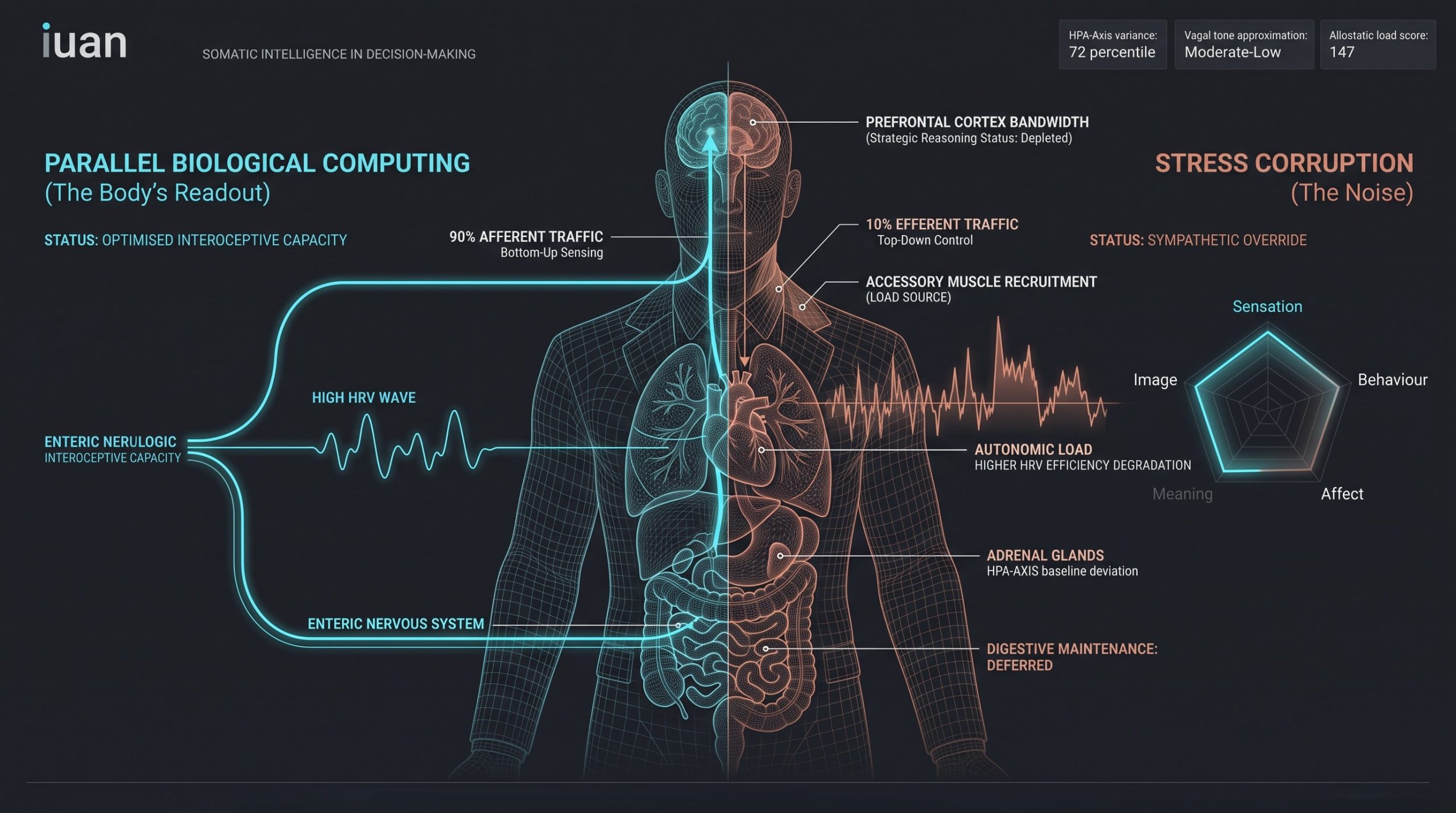
When faced with complex, high-stakes professional decisions, executives are conditioned to rely exclusively on top-down, analytical reasoning. However, neuroanatomy reveals that your body is not merely a passive vehicle carrying your thinking mind from meeting to meeting. Rather, it is a primary, parallel-processing sensing system that integrates complex environmental, relational, and historical data long before your conscious mind forms an explicit thought.
Restoring your ability to accurately read these body-based signals is not a vague wellness pursuit; it is a critical decision-making upgrade.
The 90/10 Highway: Viscera as Primary Sensing Organs
The anatomical foundation of somatic intelligence rests on a single, frequently overlooked neuroanatomical fact: approximately 90% of the vagus nerve’s fibres are afferent, carrying information upward from the body to the brain. Only 10% of vagal traffic travels in the opposite direction (efferent, brain-to-body).
This means your visceral organs, specifically your gut, heart, and lungs, are primary sensing instruments. They continuously generate data about your internal state and immediate environment, transmitting it upward to the brainstem and limbic system.
Your prefrontal cortex sits at the top of this information stack, receiving a picture of the world that has already been filtered, weighted, and emotionally coloured by the subcortical and visceral systems below it. What you experience as purely rational analysis is, in significant part, a post-hoc narrative constructed over a somatic substrate that was processed several hundred milliseconds earlier.
Parallel Biological Computing vs. Serial Analysis
The enteric nervous system embedded in the lining of your gastrointestinal wall contains over 100 million neurons, a neural network of sufficient complexity that it is often termed the “second brain”.
While your prefrontal cortex processes information serially (one thought at a time), your viscera function as a parallel biological computing system. Your gut, heart, and lungs simultaneously integrate thousands of variables, including non-verbal relational cues, acoustic micro-patterns, historical precedents, and subtle environmental shifts.
The Somatic Marker Hypothesis demonstrates that body-based sensations transmitted via the vagal pathway provide a rapid, parallel evaluation of choices. In high-stakes environments, these somatic markers narrow the decision field rapidly, providing a pre-verbal assessment that serial analytical computing alone cannot compute fast enough.
When Stress Corrupts the Signal: The Cost of Dysregulation
The primary reason analytical professionals distrust “gut feelings” is that chronic dysregulation systematically corrupts the signal.
Neuroscientists note that “muscular and visceral states colour both our perceptions and our evaluation of the intentions of others”. Under chronic sympathetic activation or allostatic load, your visceral sensing system does not shut off; instead, it operates through a distorted threat filter:
-
Neutral ambiguity reads as threat: A gut contraction that should accurately warn of a counterparty’s unreliability is triggered instead by routine ambiguity.
-
Genuine alignment is suppressed: An open chest that should signal alignment with a strategic direction is overridden if the choice touches past stress triggers.
-
Risk assessment is distorted: High-risk opportunities and routine, unfamiliar tasks generate identical internal alarm signals, destroying your ability to differentiate genuine risk.
Restoring interoceptive accuracy clears this threat filter, restoring your body’s prior-probability system so you can read biological data as clean information rather than reactive noise.
The “Felt Sense” and the SIBAM Framework
To track somatic intelligence systematically, evidence-based somatic practice uses two primary frameworks:
-
The Felt Sense: A pre-verbal, physically located sensation that carries the body’s holistic readout of a situation. It is not an emotion or a vague hunch, but an integrated physical readout.
-
The SIBAM Model: Tracks experience across five distinct somatic channels: Sensation, Image, Behaviour, Affect, and Meaning. By tracking physical Sensations (kinaesthetic, proprioceptive, and visceral) before jumping to cognitive Meaning, you prevent premature intellectual overrides and access deeper pattern recognition.
The 3-Minute Somatic Check-In Protocol;
Deploy this structured 3-minute sequence before any major decision, negotiation, board meeting, or strategic choice:
-
Step 1: Arrive (30 seconds) 3 slow nasal exhales; physical stillness; feet flat on floor.
-
Step 2: Introduce (30 seconds) Hold the decision/person lightly in awareness without analysing.
-
Step 3: Scan Belly (30seconds) Note: Expanded or contracted? Open or guarded? Warm or cool?
-
Step 4: Scan Chest (30seconds) Note: Heavy or light? Tight or available? Hands warm or cold?
-
Step 5: Ask Question (60seconds) Ask: “What is my body already knowing about this situation?”
The Golden Rule: Regulate First, Then Inquire
The accuracy of somatic intelligence depends strictly on your baseline autonomic state. If your nervous system is in acute hyperarousal or flooded with stress chemistry, your body will generate distorted threat noise rather than accurate intelligence.
Always regulate first, then inquire. If you notice significant activation, run a 90-second Neuroception Interrupt or a 2-minute breathing reset before applying the Somatic Check-In. A regulated 3-minute check-in provides a clean data channel, allowing you to combine the precision of analysis with the profound depth of somatic pattern recognition.
iuan & iuan Academy provides educational resources and performance coaching, not medical services or clinical treatment.
© 2026 iuan · iuan Academy | iuan.com.au