Most high-performing professionals approach burnout as a failure of mindset, resilience, or time management. The reality is entirely different: you are not broken, but you are physiologically overloaded. Your body is not malfunctioning. Rather, it is executing a threat-response protocol with extraordinary efficiency, one that evolved over hundreds of millions of years to handle predators, not back-to-back board meetings and late-night emails.
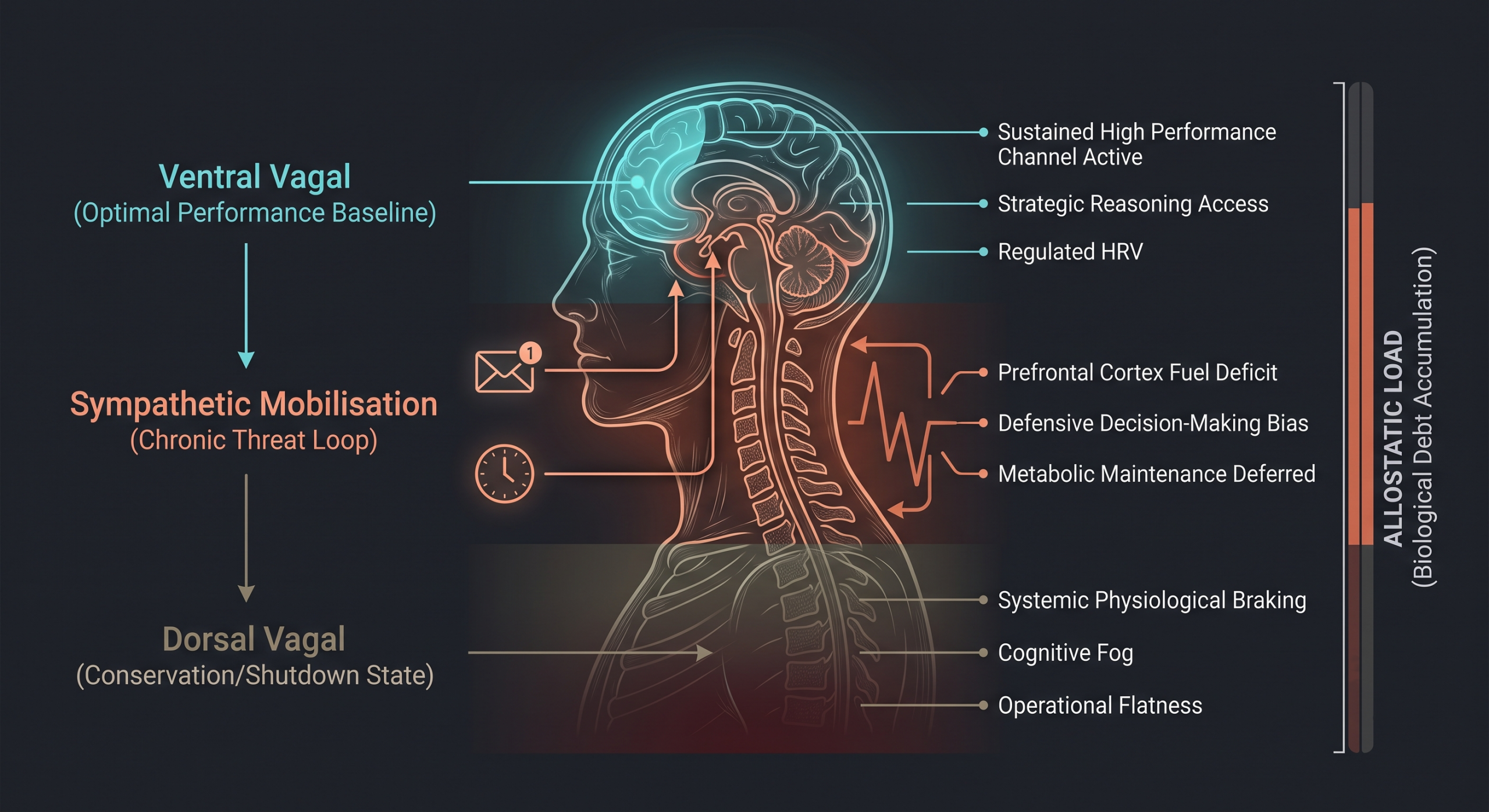
To understand executive burnout, we must reframe the autonomic nervous system (ANS) not as a pathology, but as a biological performance system. Grounded in Polyvagal Theory, the ANS operates as a hierarchical three-state system, with each branch representing a distinct physiological strategy for managing your environment:
State 1: Ventral Vagal (Safe and Engaged): This is your system’s baseline of safety and connection. In this state, your heart rate is steady, your breathing is slow and diaphragmatic, and your facial muscles are soft. This is not a luxury wellness state; it is the neurological platform from which complex thinking, strategic reasoning, nuanced decision-making, and sustained high performance are actually possible.
State 2: Sympathetic (Mobilisation for Threat): When your nervous system detects a threat, real or perceived, it drops down the hierarchy into sympathetic arousal to mobilise resources for action. This is the classic fight-or-flight response. Your heart rate increases, breathing shifts to the chest, and blood is redirected to large muscle groups, depriving the prefrontal cortex of fuel. Social nuance becomes difficult, and you may become sharp, dismissive, or reactive.
State 3: Dorsal Vagal (Shutdown and Conservation): If a threat is overwhelming, inescapable, or prolonged without resolution, the nervous system engages its oldest, most primitive survival strategy: conservation. This is the freeze or shutdown response. For executives, this rarely looks like a dramatic physical collapse; instead, it manifests as decision fatigue, brain fog, emotional blunting, and a profound, disproportionate flatness.
The Threat Loop and Chronic Survival Physiology
The ANS follows this hierarchy in order: first seeking social engagement, then mobilising for threat, and finally shutting down when mobilisation becomes unsustainable. The system is highly adaptive for genuine emergencies, but the problem arises when survival physiology becomes your default operating mode.
When professionals operate in chronic sympathetic dominance without adequate recovery, their nervous system begins treating every calendar notification or unread message as a survival threat. To fuel this constant state of alert, the body continuously defers long-term maintenance functions, such as cellular repair, digestion, and restorative sleep, to fund active survival functions. Over time, this biological debt, known as allostatic load, compounds until the system begins to physically break down.
Recognising burnout as a physiological condition rather than a psychological weakness is the crucial first step to recovery. Your symptoms are the predictable, measurable consequences of an overloaded biological system that is simply doing exactly what it was designed to do.
iuan & iuan Academy provides educational resources and performance coaching, not medical services or clinical treatment.
© 2026 iuan · iuan Academy | iuan.com.au