In our previous discussions, we mapped the biochemistry of how chronic stress alters your breathing, leading to subclinical hypocapnia (carbon dioxide depletion) and a 25% reduction in cerebral blood flow. This respiratory alkalosis leaves your prefrontal cortex starved of fuel, directly causing the brain fog and decision fatigue that high performers often misinterpret as a failure of mental resilience. But knowing a mechanism exists is not the same as retraining it.
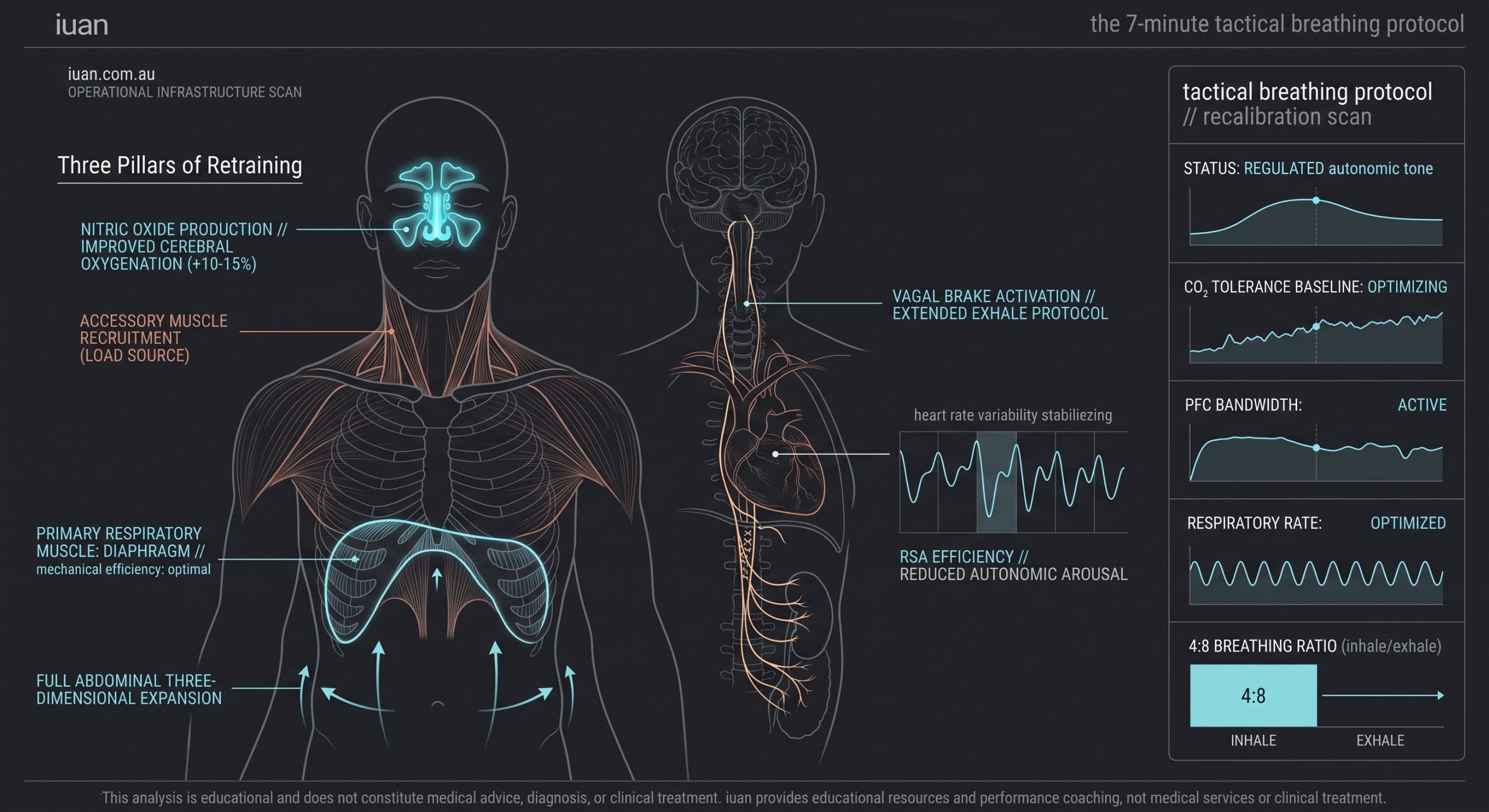
To move from temporary relief to durable physiological recovery, you must transition from a periodic “reset” to active breathing retraining. Grounded in the evidence-based respiratory framework, this retraining is built upon three non-negotiable physiological pillars:
The Three Pillars of Retraining
Pillar 1: Nasal Breathing (The Physiological Specification). The nose is not simply a passageway; it is a highly sophisticated, active organ that mouth breathing entirely bypasses. Nasal breathing produces nitric oxide in the paranasal sinuses. Nitric oxide is a potent vasodilator that improves oxygen delivery to your brain and tissues by approximately 10% to 15% while reducing airway resistance. Furthermore, nasal breathing warms, filters, and adds natural resistance to the air, which naturally slows your respiratory rate. If you habitually mouth-breathe at rest or during cognitive focus (often seen in screen-based “email apnoea”), you are operating with a measurably degraded oxygen delivery system.
Pillar 2: Diaphragmatic Engagement (Spinal and Autonomic Stability). The diaphragm is your primary respiratory muscle, designed to handle the vast majority of breathing work at rest. Under chronic stress, breathing migrates upward into the chest, recruiting accessory muscles (specifically the scalenes, sternocleidomastoids, and upper trapezius) that are not engineered for continuous use. This accessory-muscle dominance is the direct biochemical driver of the chronic shoulder girdle tightness, neck pain, and jaw tension seen in executives. Diaphragmatic breathing, where the belly expands three-dimensionally on the inhale and draws in gently on the exhale, restores mechanical efficiency and lowers muscular strain.
Pillar 3: The Extended Exhale (The Parasympathetic Lever). While the inhalation slightly mobilises the system by raising heart rate, the exhalation is the regulatory phase of the breath. An extended exhale stimulates the vagus nerve, engaging the vagal brake and initiating parasympathetic downregulation. This natural oscillation between inhalation-driven cardiac acceleration and exhalation-driven deceleration is known as respiratory sinus arrhythmia (RSA). Extending the exhale is your fastest and most direct physiological lever for reducing baseline autonomic arousal.
The Air Hunger Paradox
As you begin retraining, you may initially notice a mild, uncomfortable sensation of air hunger during slower breathing. This is not a signal that you lack oxygen. Rather, it is evidence that your brainstem’s respiratory centre has recalibrated to tolerate a chronically depleted CO₂ baseline, registering healthy, slower breathing as aversive. By continuing the protocol, you retrain your brainstem’s chemoreceptors to accept normal, healthy CO₂ levels once again, and this discomfort typically dissolves within one to two weeks of consistent daily practice.
The Deployable Tool: The 7-Minute Tactical Breathing Protocol
Unlike passive mindfulness, the Tactical Breathing Protocol is an active, structured physiological tool validated across high-stakes performance environments. At full implementation, completing this protocol twice daily for three to four weeks normalises your CO₂ baseline so effectively that it regularly replaces the need for caffeine as a focus-onset mechanism.
Find a comfortable seated position with your spine erect, mouth closed, and one hand placed on your abdomen. Complete this sequence:
Phase 1: Observe (2 Minutes) Witness your natural breathing baseline without attempting to change or judge it.
Action: Gently close your eyes or soften your gaze downward. Breathe naturally through your nose.
Somatic Tracking: Notice if the air moves primarily into your upper chest or deeper into your belly. Count your breaths silently for 60 seconds (a resting rate above 16 breaths per minute is a clear indicator of chronic overbreathing). Observe any held tension in your jaw, throat, or shoulders.
Why this matters: Directing non-judgmental attention to your breathing baseline activates prefrontal-vagal pathways, serving as an initial regulator before any physical changes are made.
Phase 2: Extend (3 Minutes) Deliver a targeted, biochemical safety signal by lengthening the exhalation.
Action: Inhale slowly through your nose for 4 counts, feeling your belly expand three-dimensionally (forward, laterally, and into the lower back) while keeping your upper chest completely still. Then, release the exhale slowly through your nose for 8 counts.
Modification: If the 4:8 ratio creates excessive air hunger or tension, temporarily compress the ratio to 4:6 or 4:7 and build up to 4:8 across the week. Do not actively push the air out; the exhale should be a controlled, relaxed release.
Why this matters: A consistent 1:2 ratio of inhalation to exhalation engages the vagal brake, reducing resting heart rate and sympathetic tone in real time.
Phase 3: Re-Observe (2 Minutes) Consolidate the shift and anchor the regulated state in your somatic memory.
Action: Release the counted ratio entirely. Return to natural, unguided nasal breathing, keeping your mouth closed.
Somatic Tracking: Simply notice the shift in your physiology. Is your breath naturally reaching further into your belly without effort? Has your resting respiratory rate dropped? Notice the quality of your attention; is it scattered and urgent, or present, gathered, and clear?
Why this matters: This phase trains interoceptive literacy, establishing a clear, physical “felt-sense” reference point of regulation that your brain can recognise and return to easily throughout the day.
When to Deploy
To integrate this practice into your daily professional life, schedule it into two specific timing windows:
The Start of the Workday: Complete the 7 minutes in your workspace before opening your inbox or entering your first meeting. This sets your CO₂ baseline and autonomic tone for the next 3 to 4 hours.
Task Transitions: Deploy Phase 1 & 2 of the protocol for 3 minutes as an active boundary between high-stakes tasks or meetings. This prevents sympathetic carryover and stops stress from compounding across your day.
iuan & iuan Academy provides educational resources and performance coaching, not medical services or clinical treatment.
© 2026 iuan · iuan Academy | iuan.com.au