Over the previous articles, we have mapped our autonomic nervous system, recalibrated our breathing mechanics, restored our vagal brake, discharged stored survival energy, identified our true Window of Tolerance, accessed somatic intelligence for decision-making, and designed a regulatory architecture.
Now it’s time to possess an accurate, non-pathologising map of our body and a direct, embodied experience of what the ventral vagal state actually feels like. However, the most critical phase of nervous system regulation begins after the formal structure concludes.
The Neuroscience of Relapse: Why Gains Are Initially Fragile
Research into physiological and behavioural change identifies a single, highly predictable failure mode following structured interventions: premature return to previous operating conditions.
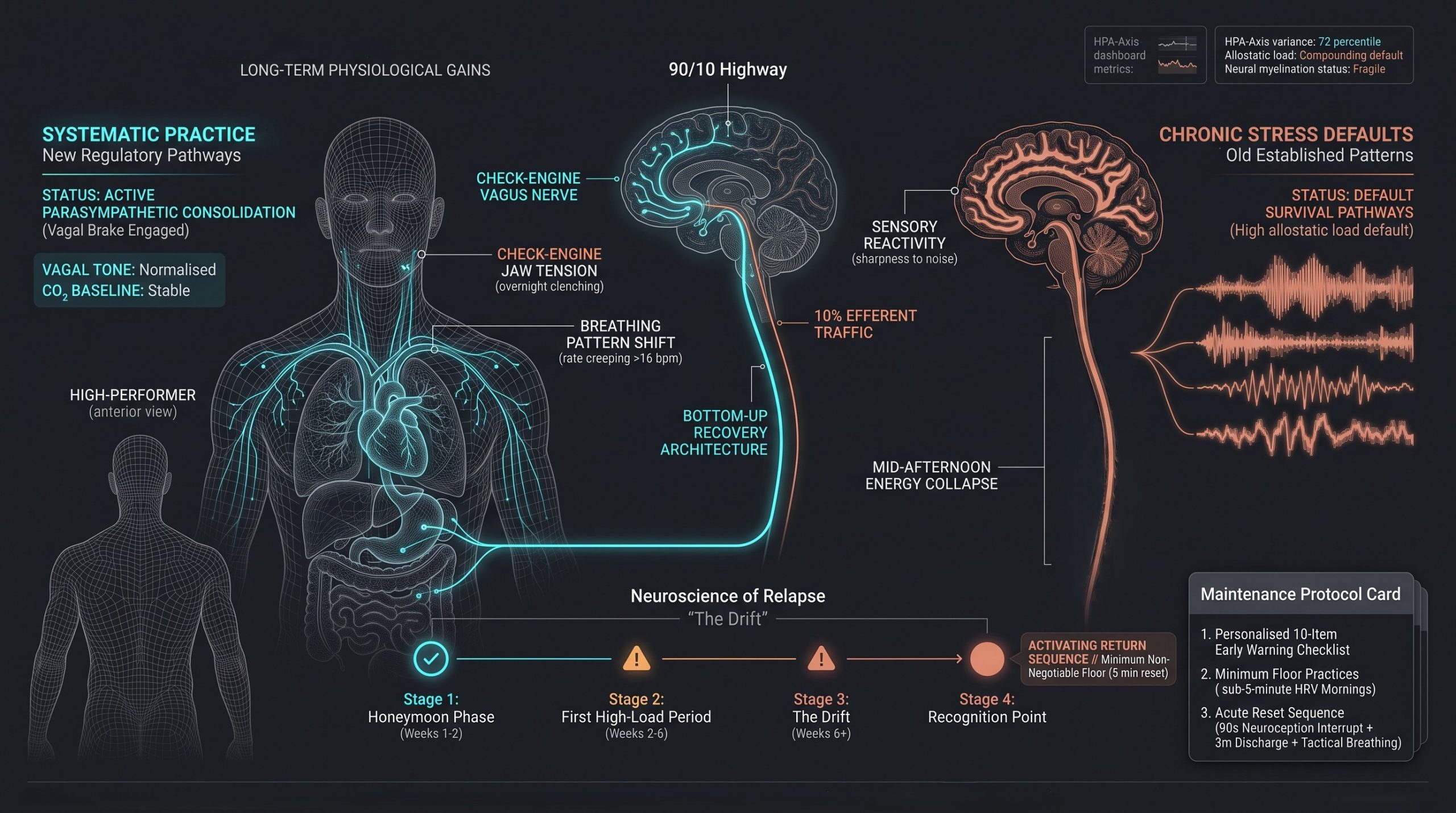
The physiological gains built across systematic practice, improved vagal tone, a reduced resting respiratory rate, normalised carbon dioxide CO₂ baselines, and an expanded Window of Tolerance are real and measurable. However, in the early resources following the conclusion of a structured program, these newly established neural pathways are initially fragile.
The neural circuitry underlying chronic stress patterns was established over years or decades of continuous repetition. These default survival pathways are deeply myelinated, highly efficient, and require almost no activation energy to fire. Conversely, your new regulatory pathways are less myelinated and require ongoing activation to consolidate.
When a period of high allostatic load arrives, the nervous system naturally defaults to its most established, least effortful pathways. This reversion is not a personal failure, a lack of discipline, or evidence that the protocols failed. It is simply neuroplasticity operating in reverse, the predictable result of removing the regulatory inputs that sustain the newly built capacity.
The Honeymoon Phase: Allostatic load is low, sleep is restored, and daily practices feel effortless and rewarding.
The First High-Load Period: An acute deadline, travel, or crisis occurs. Individual practices are compressed or skipped.
The Drift: As daily inputs drop, sympathetic tone creeps upward. Sleep becomes lighter, jaw tension returns, and the Window of Tolerance narrows.
The Recognition Point: The professional registers that they have drifted back toward their starting baseline.
Your Physiological Early Warning System (“Check-Engine Lights”)
Mastery does not mean preventing stress from ever arising; it means establishing a functional physiological early warning system to catch the drift before it becomes an allostatic flood.
Rather than waiting for acute breakdown, monitor the subtle, early indicators that appear weeks before severe overload:
Sleep quality declining: Taking longer to fall asleep, or waking between 2:00 am and 4:00 am with a problem-scanning mind.
Jaw tension upon waking: Clenching or grinding teeth overnight, signalling sympathetic intrusion into your rest window.
Reduced social warmth or humour: Interactions feeling transactional; performing connection rather than experiencing it.
Mid-afternoon energy collapse: Disproportionate fatigue in the 2:00 pm-4:00 pm window.
Breathing pattern shifts: Respiratory rate creeping above 16 breaths per minute at rest, or migrating into the upper chest.
Early-arriving decision fatigue: Straightforward decisions requiring disproportionate cognitive effort late in the day.
Sensory reactivity: Heightened sensitivity or sharpness in response to noise, interruptions, or ambiguity.
The Core Rule: When any two or more of these signals appear simultaneously for three or more consecutive days, that is your physiological check-engine light. It is not a crisis or a cause for self-criticism it is a direct biological instruction to immediately drop to your minimum non-negotiable floor and restore your structural anchors.
Real-World Adaptation: Compressing Intelligently
During travel, acute business crises, or physical illness, executing a full daily architecture may be unfeasible. In these high-demand contexts, the key is to compress intelligently rather than abandon entirely:
Protect the Minimum Non-Negotiable Floor: Maintain your two highest-yield, sub-5-minute practices (such as the 5-minute morning HRV protocol and one 3-minute transition breathing reset) regardless of circumstances. A 3-minute daily practice maintained consistently far outperforms an 8-minute practice executed sporadically.
Increase Discharge Frequency: Deploy the 3-Minute Discharge Protocol multiple times daily after high-activation events (negotiations, difficult calls, or travel transitions) to prevent residual arousal from compounding across the day.
Adapt for Illness: During physical illness, reduce practice intensity. Passive listening to downregulation audio or practising the low-effort Orienting Protocol keeps regulatory pathways open without draining metabolic energy.
What Mastery Actually Looks Like
Mastery of nervous system regulation is frequently misunderstood as a permanent state of unflappable calm. Neurobiologically, this is incorrect.
Mastery does not mean the absence of activation. It means operating as a responsive professional a system that meets genuine intensity appropriately, recovers efficiently without storing residual arousal, and maintains access to prefrontal reasoning and relational warmth under load.
When you maintain your regulatory architecture over months and years, the neural pathways built by somatic practice become the path of least resistance. The Window of Tolerance widens, recovery times shorten from hours to seconds, and your baseline allostatic load drops permanently. You cease running your physiology on willpower alone, allowing sustained high performance to become the natural, effortless byproduct of intelligent architectural design.
iuan & iuan Academy provides educational resources and performance coaching, not medical services or clinical treatment.
© 2026 iuan · iuan Academy | iuan.com.au