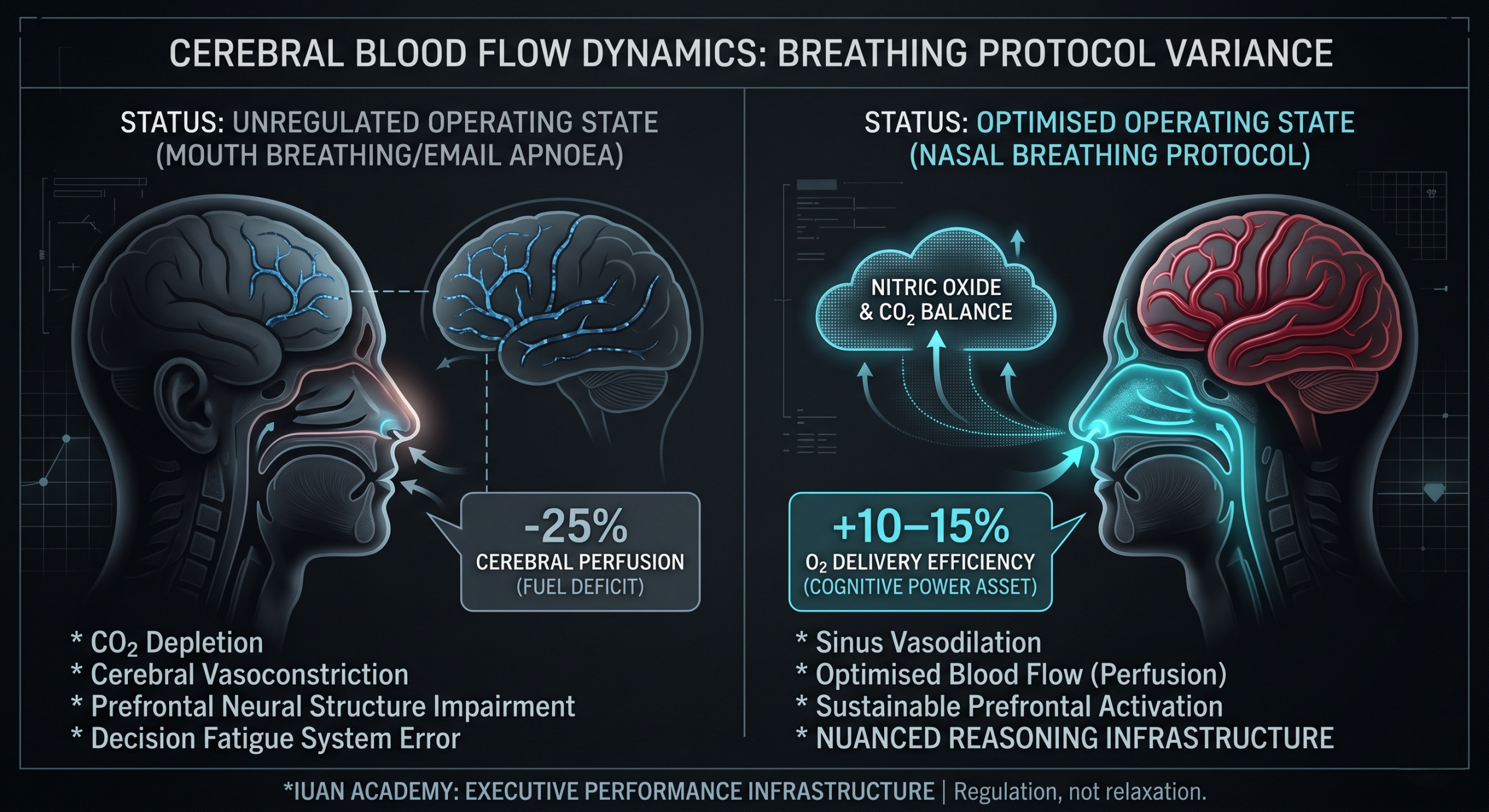
Nasal breathing directly enhances your cognitive capacity at work through two primary biological mechanisms: optimising oxygen delivery and regulating blood flow to your prefrontal cortex.
1. Nitric Oxide Production and Oxygen Delivery Unlike mouth breathing, nasal breathing produces nitric oxide in your paranasal sinuses. Nitric oxide is a powerful vasodilator that improves oxygen delivery to your tissues, including your brain, by approximately 10 to 15% and reduces airway resistance. Mouth breathing entirely bypasses this mechanism, resulting in a measurably reduced oxygen delivery system.
2. CO₂ Balance and Cerebral Blood Flow Many high-performing professionals unknowingly default to mouth breathing or breath-holding during focused cognitive work, a phenomenon sometimes referred to as “email apnoea”. This habit drives a pattern of subtle overbreathing, which depletes carbon dioxide (CO₂) in your blood.
As discussed previously, CO₂ is a critical regulatory molecule that governs cerebral blood flow. When you overbreathe through your mouth, the resulting drop in CO₂ causes cerebral vasoconstriction. A 25% reduction in arterial CO₂ produces an approximate 25% reduction in blood flow to the brain. This directly deprives your prefrontal cortex of fuel, impairing the exact neural structures you rely on for nuanced reasoning, impulse regulation, and complex decision-making.
The Performance Impact Nasal breathing naturally slows your respiratory rate, warms and filters incoming air, and supports diaphragmatic engagement. This normalises your CO₂ baseline, ensuring that your prefrontal cortex receives adequate blood flow.
The cognitive benefits are so significant that when professionals integrate structured nasal breathing (such as the Tactical Breathing Protocol) into their workday, the improved prefrontal blood flow often replaces the need for caffeine as a focus mechanism within three to four weeks.
© 2026 iuan · iuan Academy | iuan.com.au