The Impact of Breathing on Cognitive Performance
Breathing exerts a profound, physiological influence on both cognitive performance and decision-making, acting primarily through blood chemistry and nervous system regulation.
The Biochemical Mechanism: CO2 and Brain Fuel
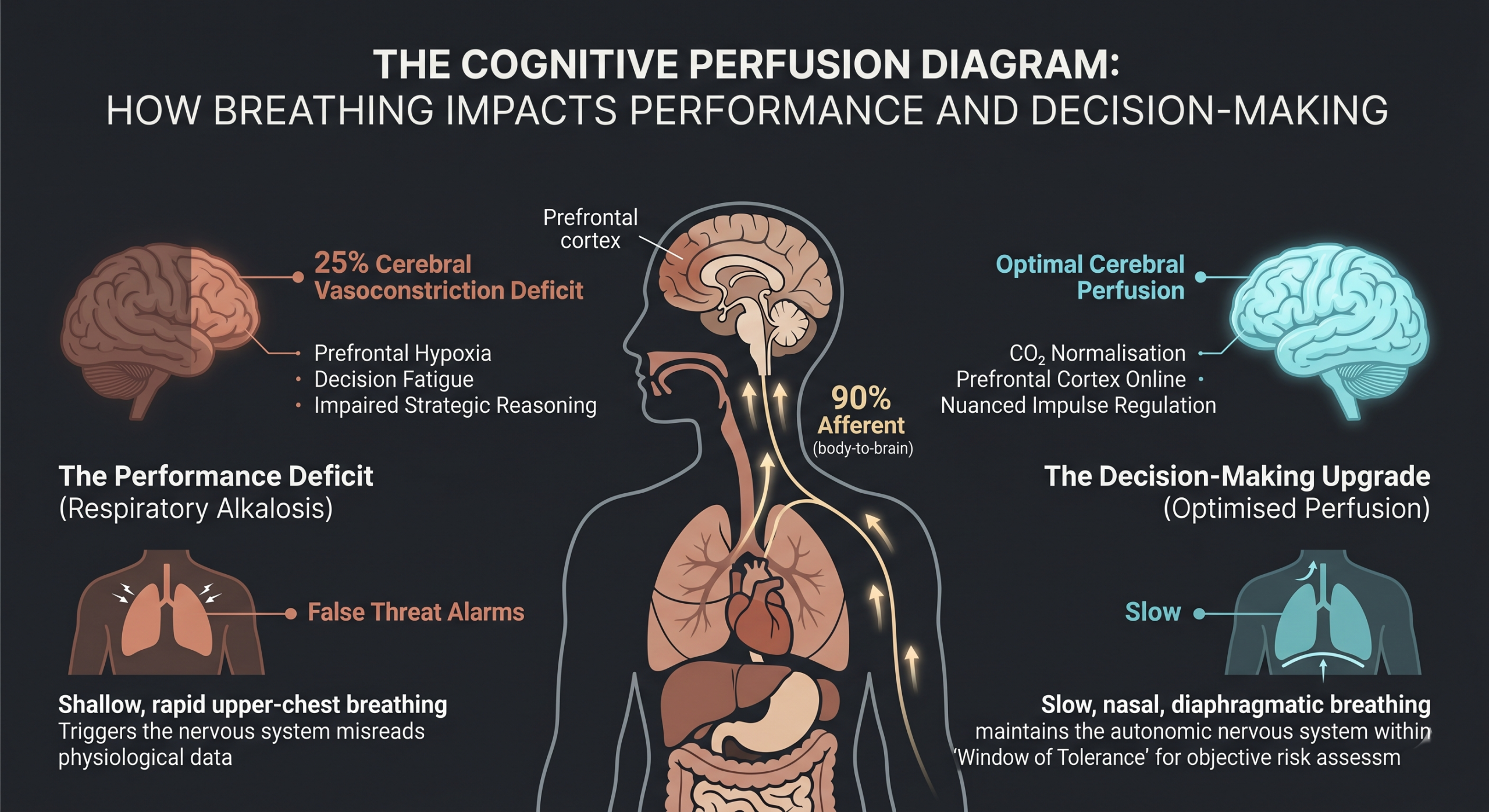
Your breathing pattern is the primary regulator of carbon dioxide (CO2) in your blood, which directly controls the diameter of your blood vessels, including those supplying the brain. When chronic stress triggers habitual overbreathing, it depletes CO2 levels and produces a state called respiratory alkalosis. Because CO2 acts as a vasodilator, this depletion causes cerebral vasoconstriction, which literally restricts blood flow to the brain.
Research indicates that a 25% reduction in arterial CO2 (or even a drop of just a few millimetres of mercury) can reduce cerebral blood flow by 25% or more. This genuinely impairs the prefrontal cortex, which is the brain region responsible for strategic reasoning, impulse regulation, nuanced communication, and complex decision-making.
Cognitive Performance Deficits
Because overbreathing starves the brain of its necessary fuel, it forces the system to operate in a state of prolonged central hypoxia. This physiological impairment directly counteracts alertness and effective thinking. As a result, individuals may experience severe cognitive deficits, including:
- Poor concentration and memory lapses.
- Impaired motor coordination and slowed reaction times.
- Compromised judgment and general intellectual functioning.
- Mental fogginess and an inability to think clearly.
Impact on Decision-Making and Somatic Intelligence
Breathing also heavily influences the nervous system’s capacity to assess risk and make sound choices. Complex decision-making and long-term strategic reasoning are neurologically available only when the nervous system operates within its optimal arousal zone, known as the “Window of Tolerance”.
Furthermore, your visceral organs (including the lungs, gut, and heart) act as a massive biological computing system, sending 90% of the vagus nerve’s traffic upward to the brain to inform it about your environment. When poor breathing habits keep your body in a state of chronic sympathetic activation (fight-or-flight), your nervous system systematically misreads these internal sensations as threat data.
Because your neuroception (your subconscious threat-detection system) processes these internal physiological signals before your conscious mind has time to act, it generates false alarms. Consequently, decisions made under these conditions are not objective; they are systematically biased toward risk aversion, defensiveness, and avoidance.
By retraining your breathing, specifically adopting a slow, nasal, diaphragmatic pattern, you can normalise CO2 levels, restore optimal blood flow to the prefrontal cortex, and recalibrate your body’s threat-detection system. For this reason, clinical experts view the restoration of healthy breathing not just as a wellness goal, but as a literal “decision-making upgrade”.
© 2026 iuan · iuan Academy | iuan.com.au