For high-performing individuals and founders, sleep disruption is almost universally a nervous system problem, not a sleep problem. Standard sleep advice treats insomnia as a behavioural failure, prescribing sleep hygiene rules like keeping the room cool, using blackout blinds, or cutting caffeine by early afternoon. While not inherently wrong, these recommendations are insufficient for chronically stressed professionals because they address the surface conditions of sleep without addressing why the autonomic nervous system cannot access it.
What Sleep Actually Requires: “Immobilisation Without Fear”
Restorative slow-wave and REM sleep are active biological processes that require specific autonomic conditions to initiate. Grounded in Polyvagal Theory, deep rest requires what is described as “immobilisation without fear”, the low-tone dorsal vagal state of conservation and repair, activated within an absolute context of perceived safety.
To access this state, your nervous system must complete two distinct physiological shifts:
-
Downregulate from sympathetic arousal: The stress chemistry of the day (cortisol, adrenaline, and elevated heart rate) must be metabolised or discharged.
-
Register environmental safety: Subconscious neuroception must assess your immediate environment as completely safe to allow the physiological vulnerability of unconsciousness.
When you spend the final 90 minutes of your evening responding to urgent emails, reviewing tomorrow’s schedule, consuming news, or engaging in high-stakes problem-solving, you arrive at the sleep window with a nervous system still mobilised for threat. Your body may be horizontal and the room quiet, but your autonomic state remains activated. The result is the classic presentation of executive insomnia: lying awake with a racing, problem-scanning mind, unable to switch off.
The Hidden CO₂ Connection and Nocturnal Awakenings
There is a second, largely unrecognised biochemical mechanism driving executive sleep fragmentation. As established in earlier modules, chronic overbreathing during the day depletes carbon dioxide CO₂ levels, causing the respiratory centre in the brainstem to recalibrate to a lower-than-normal CO₂ baseline.
During normal sleep, breathing naturally slows, and CO₂ levels rise slightly, a healthy aspect of overnight respiratory chemistry. However, when your brainstem has been recalibrated to a depleted CO₂ baseline, it misinterprets this natural nocturnal rise in CO₂ as a suffocation alarm. This triggers a micro-awakening or a spike in sympathetic arousal, frequently causing executives to wake suddenly between 2:00 am and 4:00 am with an active mind and a pounding heart.
Furthermore, habitual mouth breathing during sleep perpetuates this CO₂ dysregulation overnight. Bypassing the nasal passages eliminates the production of vasodilating paranasal nitric oxide, increases airway resistance, and maintains low-grade sympathetic arousal throughout the night.
Why Willpower Strategies Collapse Under Load
Relying on willpower or discipline to “force” a sleep routine, such as trying to meditate or mentally quiet a racing mind, inevitably fails under high professional pressure. Executing discipline-based strategies requires prefrontal cortex resources. However, the prefrontal cortex is the exact neural structure most degraded by chronic stress, allostatic overload, and subclinical hypocapnia.
Attempting to force sleep using an impaired prefrontal cortex creates a self-defeating loop. The solution is a pre-sleep protocol structured around autonomic downregulation, working directly with the nervous system’s architecture rather than against it.
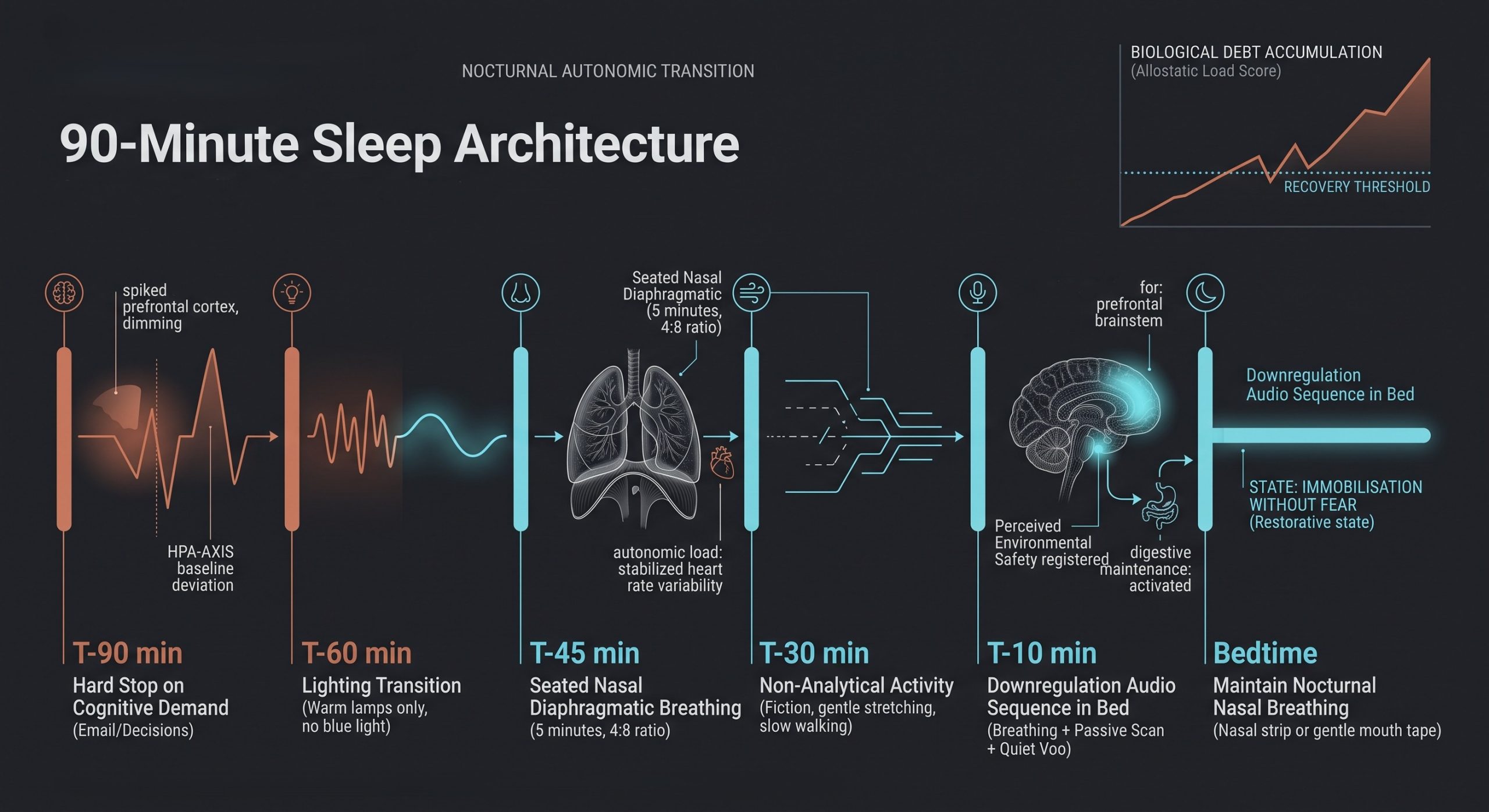
The 90-Minute Sleep Preparation Protocol
This protocol systematically removes sympathetic drivers and introduces targeted safety cues across the final 90 minutes of your evening:
-
T-90 Minutes – Hard Stop on Cognitive Demand: Cease all work-related emails, decision-making, and planning. Externalise unfinished tasks onto a physical notepad so your prefrontal cortex does not need to hold them overnight.
-
T-60 Minutes – Lighting Transition: Dim overhead lights completely and switch to warm, low-level lamps below eye level. Blue-spectrum and fluorescent lighting suppress melatonin release via the suprachiasmatic nucleus; warm light signals circadian dusk.
-
T-45 Minutes – Seated Breathing Reset: Spend 5 minutes practising seated, nasal diaphragmatic breathing with an extended exhale (4-second inhale, 8-second exhale). This delivers a direct parasympathetic signal, initiating vagal brake engagement.
-
T-30 Minutes – Non-Demand Activity: Engage in activities that require zero executive function or emotional processing, such as reading fiction, gentle floor stretching, or quiet conversation.
-
T-10 Minutes – Downregulation Audio Sequence: In bed, listen to the downregulation sequence. This combines slow diaphragmatic breathing, passive body awareness (not effortful progressive muscle relaxation), and a low-volume, internal sound to guide the system into dorsal vagal rest.
-
Bedtime – Nocturnal Nasal Breathing: Ensure exclusive nasal breathing overnight using an external nasal strip or medical mouth tape (if safe for you without airway obstruction) to stabilise overnight CO₂ chemistry and protect sleep architecture.
By replacing effort with physiological architecture, you provide your nervous system with the biological conditions required to shift out of survival mode and enter deep, restorative sleep.
iuan & iuan Academy provides educational resources and performance coaching, not medical services or clinical treatment.
© 2026 iuan · iuan Academy | iuan.com.au