Previously, we have explored the neurobiology of the autonomic nervous system, breathing mechanics, vagal tone, and somatic intelligence. You now understand why your body responds to pressure the way it does, and what specific tools can shift your physiology. However, when high-performing executives attempt to implement these regulatory practices, they frequently encounter an uncomfortable reality: under high professional load, precisely when regulation is most critical, relying on willpower to execute a routine almost always fails.
This failure is not a character flaw, a lack of discipline, or a weakness of intention. It is a physiological constraint.
The Willpower Paradox
The prefrontal cortex resources required to maintain a discipline-based approach to stress management remembering to pause, choosing to breathe, forcing yourself to stop working, are drawn from the exact same depleted cognitive pool consumed by high allostatic load. The higher your stress, the less prefrontal capacity you have available to initiate the very practices designed to reduce that stress.
To build a sustainable operating state, you must shift from discipline to architecture.
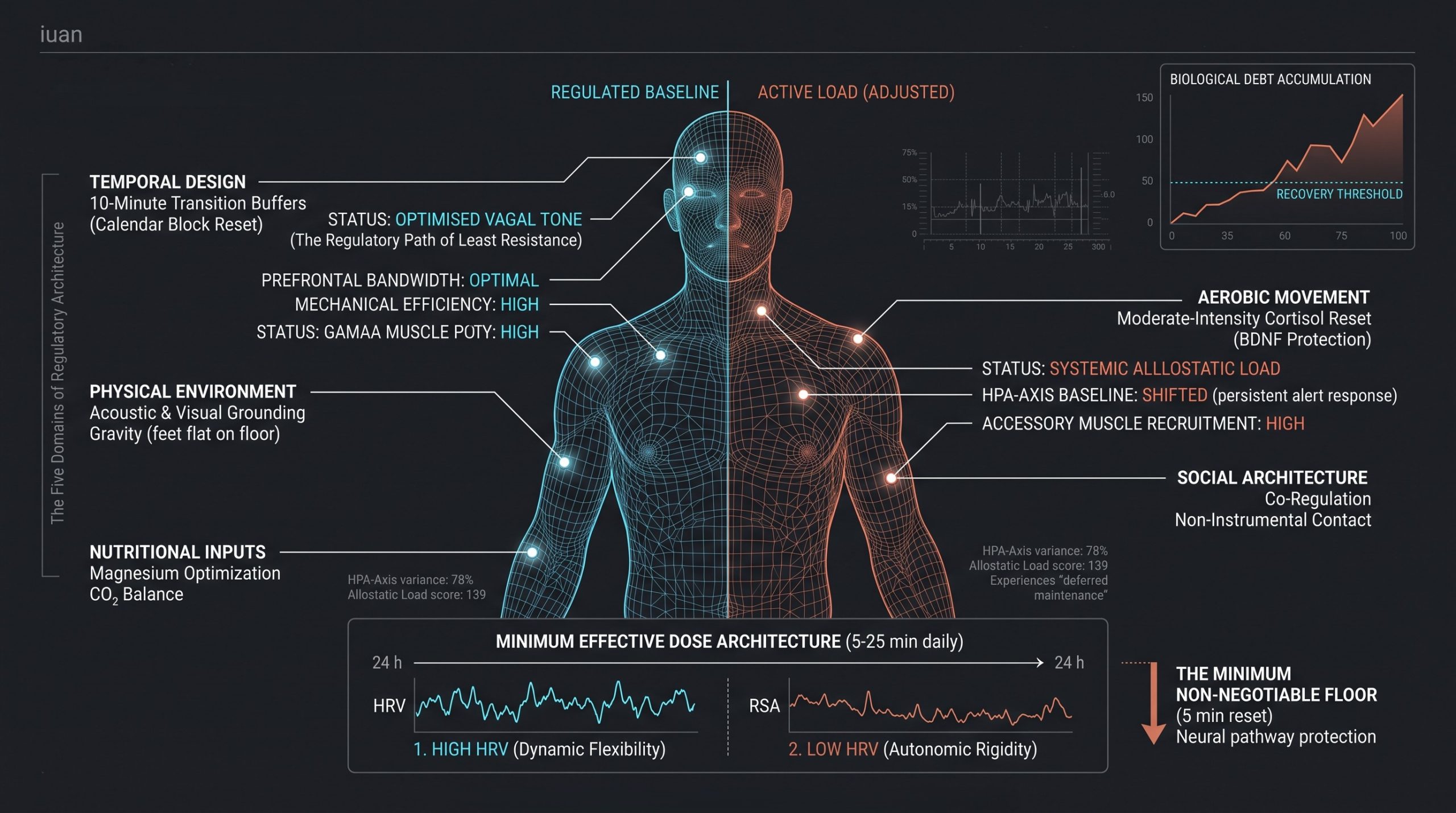
Regulatory environment design relocates the burden of regulation from fragile, moment-to-moment willpower to your physical, temporal, and social infrastructure. Just as elite athletic performance depends on structured training architectures rather than in-the-moment motivation, executive physiological sustainability requires designing an environment where regulation is the path of least resistance.
The Five Domains of Regulatory Architecture
A complete regulatory architecture restructures five core environmental domains to lower your baseline allostatic burden automatically:
1. Temporal Design: Meeting Rhythm & Transition Buffers. The back-to-back meeting schedule is the single most universal structural driver of compounding allostatic load in modern organisations. Each high-stakes engagement, whether a negotiation, board presentation, or difficult conversation, triggers a physiological activation cycle. When meetings are scheduled back-to-back without recovery gaps, activation compounds across the day, forcing your prefrontal cortex to process new tasks while carrying the residual stress chemistry of previous ones.
-
The Structural Fix: Build 10-minute transition buffers into your calendar by converting 60-minute meetings into 50-minute blocks, or 30-minute meetings into 25-minute blocks.
-
The 10-Minute Sequence: Spend the first 3 minutes on the 3-Minute Discharge Protocol to clear stored survival energy; the next 4 minutes on a tactical breathing reset to restore CO₂ balance; and the final 3 minutes reviewing the upcoming engagement from a regulated baseline.
2. Physical Environment: Acoustic, Visual, and Proprioceptive Inputs. Your neuroceptive system continuously scans your physical surroundings for subconscious cues of safety or threat.
-
Acoustic Regulation: Unpredictable, high-frequency background noise and continuous digital notification sounds maintain a persistent, low-level alert response through the middle ear musculature. Silencing non-urgent notifications during deep focus blocks removes hundreds of micro-activations daily.
-
Visual Inputs: Exposure to natural sunlight, especially within the first hour of waking, serves as the primary zeitgeber (time cue) for your circadian system, anchoring your cortisol peak and setting the timing for evening melatonin release. Overhead fluorescent lighting, conversely, sustains mild circadian disruption.
-
Proprioceptive Grounding: Hours of static desk posture accumulate muscular tension and restrict diaphragmatic movement. Integrating brief postural shifts, standing intervals, and placing both feet flat on the floor delivers a continuous bottom-up signal of gravitational stability to the brainstem.
3. Nutritional Inputs and Neural Excitability. Nutrition influences nervous system stability through two primary biochemical levers:
-
Dietary Acid Load & CO₂ Balance: Diets high in refined sugars and processed foods increase systemic acid load, forcing the kidneys to alter CO₂ retention. Diets rich in magnesium (such as leafy greens, nuts, and seeds) support smooth muscle function in the airways and enhance the brain’s inhibitory neural signalling.
-
Caffeine Dependence: Caffeine acts as an adenosine receptor antagonist, masking fatigue without restoring cellular energy. When used habitually to override exhaustion, caffeine elevates your baseline sympathetic tone, narrows your Window of Tolerance, and exacerbates neural hyperexcitability. Breathing retraining naturally restores prefrontal blood flow, reducing the biological requirement for caffeine as a focus mechanism.
4. Aerobic Movement and Allostatic Load Management. Exercise is one of the most scientifically validated interventions for reducing allostatic load. It lowers circulating cortisol, elevates Brain-Derived Neurotrophic Factor (BDNF) to protect hippocampal volume, increases Heart Rate Variability (HRV), and provides an active channel for discharging bound stress energy.
-
Intensity & Volume: Moderate-intensity aerobic exercise (60-70% of maximum heart rate) for 20 to 30 minutes, 3 to 4 times per week, yields optimal regulatory benefits. High-intensity interval training (HIIT), while metabolically efficient, spikes adrenaline and cortisol, which can be counterproductive for an already overloaded system.
-
Timing: Morning movement provides durable cortisol-regulating effects throughout the working day. Avoid vigorous exercise within 3 hours of sleep to prevent night-time sympathetic arousal.
5. Social Architecture: The Neuroscience of Co-Regulation. Polyvagal Theory establishes that the mammalian ventral vagal social engagement system evolved specifically for co-regulation, the process by which two regulated nervous systems calm each other through vocal prosody, facial expression, and eye contact.
-
Instrumental vs. Non-Instrumental Contact: Professional interactions are predominantly instrumental, transactional, outcome-oriented, and performance-driven. Instrumental contact requires impression management and maintaining a sympathetic tone.
-
The Biological Requirement: Non-instrumental social connection, authentic, unhurried contact with trusted individuals without an evaluation or outcome agenda, is one of the most potent autonomic regulators available. Structuring non-transactional contact into your week is a biological necessity for vagal recovery.
The Deployable Tool: The Regulatory Architecture Blueprint.
Iuan Academy’s the Integration Blueprint course explores how to operationalise these five domains without relying on willpower, assembling a Minimum Effective Dose Architecture. A complete structure requires approximately 25 minutes of deliberate practice spread across your day, less time than most executives spend on email before 8:00 am.
The Minimum Non-Negotiable Floor. On travel days, during acute business crises, or during illness, executing a full 25-minute architecture may be unfeasible. Rather than abandoning your practices entirely, drop to your Minimum Non-Negotiable Floor: two foundational practices taking less than 5 minutes combined (typically the 5-minute HRV Morning Protocol and one 3-minute transition reset).
Maintaining a 3-minute practice every day protects your neural pathways far more effectively than completing a 20-minute routine sporadically. By building structure over discipline, your environment maintains your physiology, allowing high performance to become a sustainable outcome of design rather than an exhausting act of will.
iuan & iuan Academy provides educational resources and performance coaching, not medical services or clinical treatment.
© 2026 iuan · iuan Academy | iuan.com.au