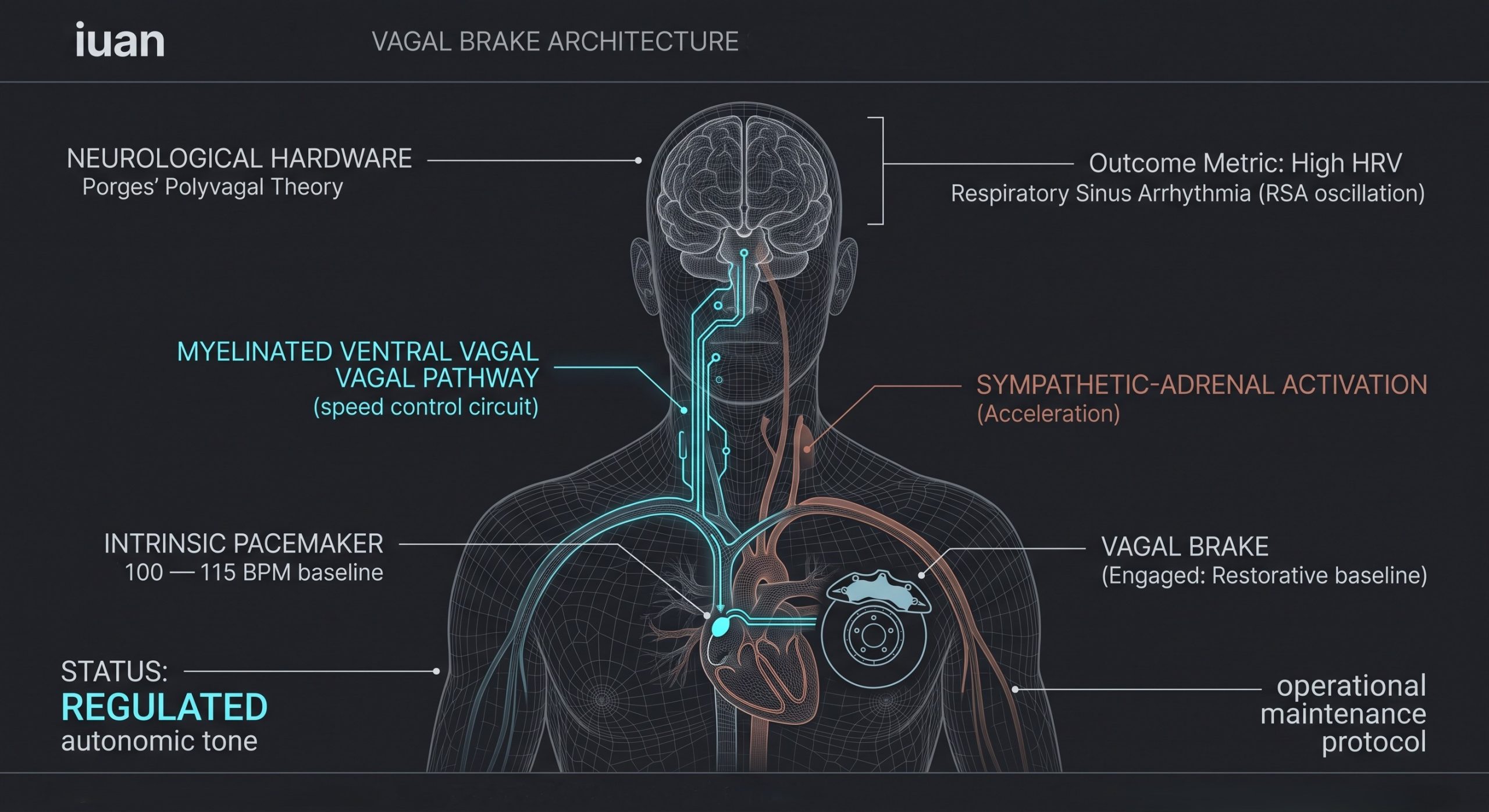
In our previous discussions, we established that chronic physiological overload narrows your window of tolerance and degrades your breathing mechanics, starving your prefrontal cortex of vital blood flow. But to fully modify your stress reactivity rather than just manage its symptoms, we must understand the precise neurological mechanism that governs your body’s capacity to recover the vagal brake.
Grounded in Polyvagal Theory, the vagal brake is your body’s built-in, real-time speed controller for your heart. When you understand how to cultivate and leverage this neurological hardware, you can meet high-stakes professional demands without triggering the exhausting cortisol and adrenaline cascades that drive executive burnout.
The Anatomy of High-Speed Recovery
Your heart possesses its own intrinsic pacemaker, the sinoatrial (SA) node, which spontaneously generates electrical signals to contract your heart muscles. Left completely to its own devices, this pacemaker would dictate a resting heart rate of approximately 100 to 115 beats per minute. To keep your resting heart rate at a lower, more energy-efficient level, your nervous system must actively slow it down.
It achieves this through the myelinated ventral vagal pathway of the parasympathetic nervous system. The ventral vagus nerve acts like a hand resting lightly on your heart’s accelerator:
During Safety: The vagal brake is fully engaged, holding your resting heart rate down to a calm, restorative baseline.
During Demand: When you face an acute challenge, such as a high-stakes presentation, a difficult negotiation, or a crisis, your system does not need to flood itself with stress chemicals to raise your heart rate. Instead, your nervous system simply lifts the vagal brake. This allows your heart rate to climb instantaneously and cleanly, providing the metabolic energy required to meet the moment.
During Recovery: Once the demand resolves, a well-calibrated vagal brake re-engages within seconds, rapidly returning your heart rate to its resting baseline.
Because the ventral vagus nerve is myelinated (insulated by a protective fatty sheath), it conducts electrical signals with extreme speed and precision. This allows you to navigate the intense oscillations of a demanding workday without recruiting the slower, highly taxing sympathetic-adrenal system. You get the metabolic energy you need without the adrenaline hangover or the residual physiological activation that usually ruins the rest of your afternoon.
What Happens When the Brake Degrades
Under the weight of chronic allostatic overload, this finely tuned system begins to degrade. When the nervous system is subjected to relentless, unresolved pressure without recovery intervals, the myelinated ventral vagus loses its precise, modulating control.
The biological consequences are gradual but highly destructive:
Resting Heart Rate Creeps Upward: Because the vagal brake is no longer holding your pacemaker down effectively, your baseline heart rate rises.
Recovery Times Balloon: After a stressful meeting or a frustrating email, your heart rate remains elevated for hours rather than returning to baseline in seconds.
The Sympathetic Threshold Drops: Your system begins defaulting to full, visceral fight-or-flight stress chemistry for situations that only warrant mild alertness, such as a routine calendar reminder.
Chronic Hyperarousal Becomes the Baseline: You operate in a state of continuous, low-grade vigilance, leaving you physically “switched on” but cognitively and relationally depleted.
Your Autonomic Gauge: Heart Rate Variability (HRV)
To measure the current functional capacity of your vagal brake, we look to Heart Rate Variability (HRV). HRV measures the microscopic variations in time between consecutive heartbeats.
Contrary to popular belief, a healthy heartbeat is not metronomic like a clock. In a well-regulated individual, the heart rate naturally accelerates slightly during inhalation (as the vagal brake is briefly lifted) and decelerates during exhalation (as the brake re-engages). This healthy, rhythmic oscillation is known as respiratory sinus arrhythmia (RSA).
High HRV indicates a highly responsive, flexible vagal brake that is fluidly adjusting your physiology to your environment.
Low HRV indicates a rigid, locked system that is chronically over-activated or suppressed, leaving you with very little physiological buffer to handle stress.
By tracking your morning HRV immediately upon waking (using consumer wearables), you can monitor the depth of your overnight autonomic recovery. A gradual upward trend in your weekly HRV average is the direct, biochemical proof that your vagal brake is rebuilding its capacity.
The Deployable Tool: Sound Practice
To actively train and strengthen your vagal brake, we use a structured somatic practice called the Voo Sound.
This practice works because of a fundamental neuroanatomical reality: approximately 90% of the vagus nerve’s fibres are afferent, meaning they carry sensory information upward from your body to your brain, rather than downward. The viscera like your gut, heart, and lungs are primary sensing organs. By generating deep, resonant, and settled physical sensations in these organs, you send a powerful bottom-up signal of safety directly to your brainstem, bypassing your analytical mind entirely.
The Voo Sound is a targeted, mechanical stimulus to the vagus nerve’s sensory endings in your thorax and abdomen.
iuan & iuan Academy provides educational resources and performance coaching, not medical services or clinical treatment.
© 2026 iuan · iuan Academy | iuan.com.au