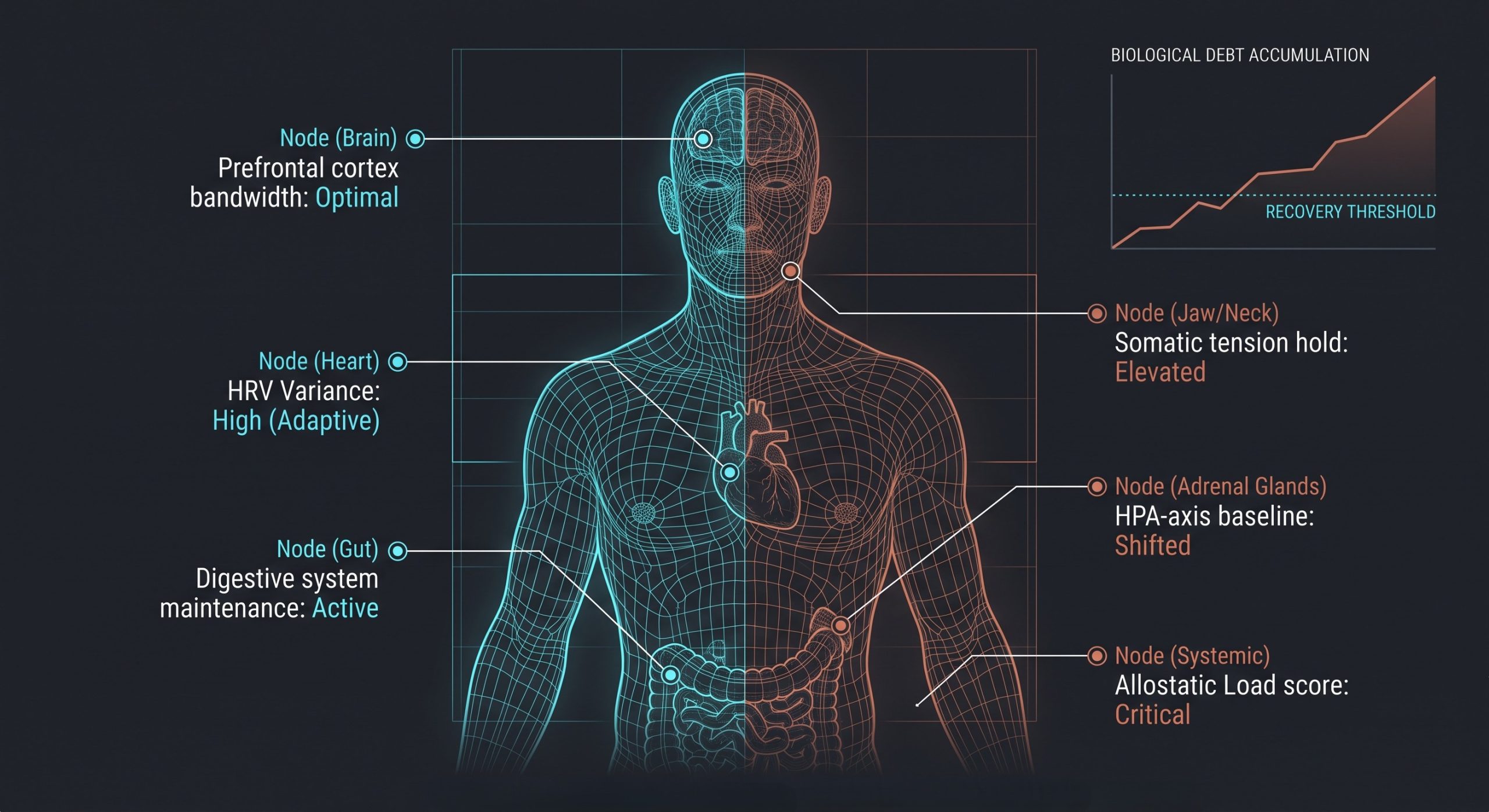
Many high-performing professionals treat their chronic fatigue, sleep issues, and irritability as personal shortcomings, a failure of mental grit, a lack of resilience, or poor time management. The reality is far more precise: burnout is not a psychological state, but a measurable biological condition driven by a depleted biological stress budget.
To recover, you must move past wellness rhetoric and understand the underlying biochemistry. This begins with a concept known as allostatic load.
Your Biological Stress Budget
Your body survives and adapts by constantly adjusting its internal systems in response to demands from your environment. This active process of maintaining stability through change is called allostasis. However, when stress is sustained at a high intensity without adequate recovery, the cost of these continuous adjustments compounds. This cumulative wear and tear on your biological systems is your allostatic load.
Think of your physiology in terms of a strict biological budget. Your body is constantly allocating limited resources between two competing accounts:
Active Survival Functions: Mobilising stress hormones (like cortisol and adrenaline), increasing heart rate and blood pressure, tensing muscles, and sharpening sensory alertness to scan for problems.
Long-Term Maintenance Functions: Sustaining restorative sleep, cellular repair, digestive function, gut microbiome health, immune surveillance, and the neuroplasticity required for long-term memory consolidation.
When survival physiology is chronically dominant, the body systematically defers long-term maintenance. It pulls resources from your maintenance account to keep your survival account funded. In the short term, this trade-off is adaptive and performance-enhancing. You deliver, you build, and you push through. But this deferral has a biological ceiling.
The Flooding Basement
Nervous system regulators describe this physiological compromise elegantly: it is the biological equivalent of setting aside a maintenance project, like painting your house, because your basement is flooding.
When the basement is actively flooding, clearing the water is the only logical priority. You divert all your energy to the emergency and pause routine housekeeping. However, if the basement is flooding chronically, day after day, your routine maintenance remains paused indefinitely. Eventually, as other areas of the house are ignored, the very structure of the building begins to break down and deteriorate.
In high performers operating under chronic allostatic load, this deferred maintenance presents as a recognisable cascade of physical symptoms:
Sleep Disruption: Difficulty falling asleep, frequent waking, or waking at 3:00 to 4:00 am with an active, problem-scanning mind. This is a neuroendocrine consequence of chronic sympathetic dominance prematurely spiking your cortisol rhythm.
Decision Fatigue: A progressive erosion of decision-making capacity late in the day as a direct result of sustained cortisol and reduced prefrontal blood flow.
Emotional Blunting: A gradual flattening of emotional responsiveness and a reduced capacity for relational warmth, humour, and genuine connection.
Somatic Symptom Accumulation: Chronic jaw clenching, neck and shoulder tightness, headaches, and gut disturbances (like bloating or irregular bowel function).
Immune Suppression: Increased susceptibility to viral illnesses and slower recovery because immune surveillance has been deprioritised.
This is not a psychological state. Allostatic overload involves documented biological changes, including altered HPA-axis and cortisol rhythms, reduced heart rate variability (HRV), elevated inflammatory markers, and a physical reduction in the volume of the hippocampus. Standard psychological strategies like cognitive reframing or positive thinking cannot fix this; you must address the physical substrate of your physiology.
The 10-Item Allostatic Load Audit
To measure your baseline with precision, complete the following educational self-inventory. Score each of the 10 indicators based on how frequently you have experienced them over the past week using a 0 to 3 scale:
0 = Never, or very rarely 1 = Occasionally (1-2 days this week) 2 = Often (3-4 days this week) 3 = Almost constantly (5-7 days this week)
Sleep disruption: Difficulty falling asleep, staying asleep, or waking early with a racing mind.
Racing or intrusive thoughts: Racing or looping thoughts when trying to rest or transition out of work.
Gut symptoms: Bloating, irregular bowel function, nausea, or a persistent sense of unease.
Chronic muscular tension: Jaw clenching or teeth grinding, neck tightness, or shoulder pain without physical cause.
Reduced social warmth and ease: Difficulty accessing genuine warmth, humour, or relaxed social engagement.
Decision fatigue: Reduced capacity for complex decision-making, particularly late in the working day.
Heightened sensory sensitivity: Increased reactivity to noise, sudden movements, interruptions, or conflict.
Loss of engagement: Flattened motivation or reduced interest in activities that previously brought pleasure.
Persistent fatigue: A background state of low-grade exhaustion not resolved by sleep or a quiet weekend.
Inability to switch off: Feeling chronically “switched on” and unable to downregulate during downtime.
Your Total Score: ___ / 30
Interpreting Your Stress Score
Your total score is a physical measurement, like blood pressure or resting heart rate. It is data, not a verdict or a cause for shame.
0-9 (Low Load): Your system is well-resourced. Regulatory practices are preventive at this stage.
10-14 (Moderate Load): Early indicators are present. Proactive downregulation will yield significant performance returns.
15-19 (Significant Load): Your system is under load. Systematic intervention is required to prevent deeper dysregulation.
20-24 (High Load): Significant physiological load is present. You must prioritise sleep and breathing protocols to stabilise your autonomic baseline.
25-30 (Acute Overload): Your physiology is indicating severe load and requires support beyond self-directed practice. Please consult a qualified health professional (GP).
The Allostatic Load Dashboard
To track the pace and direction of your physiological change, we use the Allostatic Load Dashboard. This deployable tool turns a single audit into a longitudinal dataset, allowing you to observe trends weekly.
Nervous system change is non-linear and context-dependent; a score that rises one week and falls the next is completely normal under varying occupational demands. You are tracking the overall direction across several weeks of systematic practice, not chasing a perfect score in a single week.
To build your dashboard, track your weekly audit score alongside two primary daily metrics:
Breathing Reset Minutes: Recording your daily commitment to diaphragmatic breathing practices.
Sleep Window Consistency: Logging whether you maintained consistent bed and wake times.
By tracking these biological metrics, you shift from running your physiology without a dashboard to operating it with a precise, professional instrument. Once the baseline is measured, the systematic work of physiological downregulation and recovery can begin.
iuan & iuan Academy provides educational resources and performance coaching, not medical services or clinical treatment.
© 2026 iuan · iuan Academy | iuan.com.au