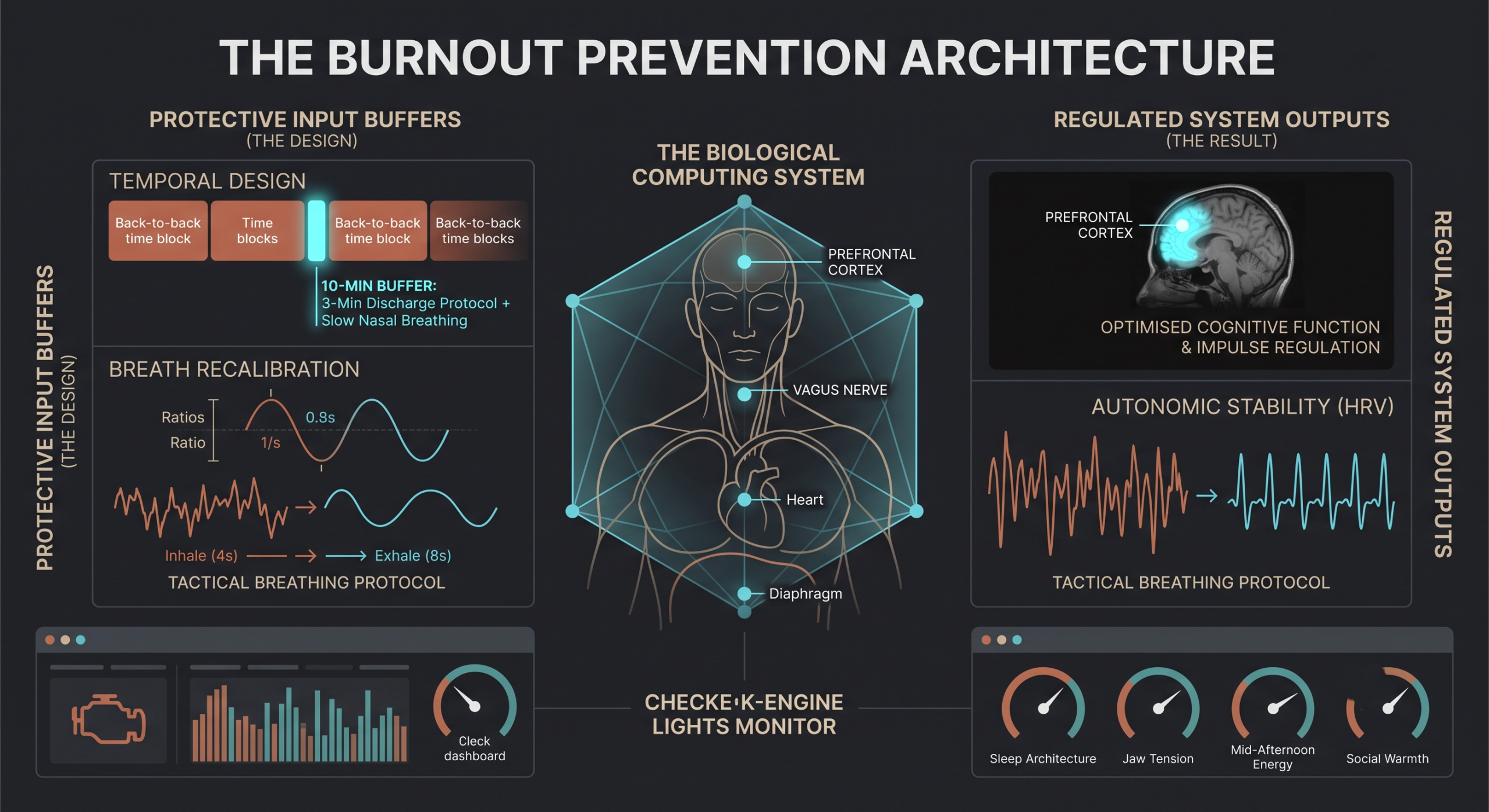
Preventing executive burnout requires a fundamental shift in how you manage your physiological resources. As we have discussed, burnout is not a psychological state, a failure of mindset, or a lack of resilience; it is a measurable biological condition driven by allostatic overload.
Because chronic stress impairs the prefrontal cortex, any prevention strategy that relies on sustained willpower or discipline will inevitably fail under high load. Instead, you must build a regulatory architecture, structuring the physical, temporal, and social conditions of your professional life to make nervous system regulation an automatic default.
Here is how you can design an architecture to prevent burnout:
1. Temporal Design: The 10-Minute Meeting Buffer.
The back-to-back meeting schedule is one of the most significant structural drivers of allostatic load. Every high-stakes engagement, whether a difficult negotiation, a board presentation, or conflict, generates a sympathetic activation cycle. When you transition immediately to the next task without recovery, this activation compounds across the day, leaving your prefrontal cortex swimming in residual stress chemistry.
The Fix: Build 10-minute buffers between significant engagements as a physiological necessity. Use this time to perform the 3-Minute Discharge Protocol we discussed previously to complete the survival energy cycle, followed by slow nasal breathing to transition into the next meeting from a regulated baseline.
2. Autonomic Anchors: Morning and Evening.
Your nervous system requires clear signals at the beginning and end of the day to set and reset its regulatory baseline.
The Morning HRV Protocol: Morning cortisol peaks 20 to 30 minutes after waking. Exposing yourself to screens, emails, and notifications during this window amplifies this cortisol response, establishing sympathetic dominance for the rest of the day. Instead, spend the first 5 minutes of your day completing a sequence of slow nasal breathing, the “voo” sound practice, and gentle environmental orienting to stimulate your vagal brake before looking at any devices.
The 90-Minute Sleep Architecture: As we covered earlier, sleep disruption is a nervous system issue, not a sleep issue. Restorative sleep requires the dorsal vagal state (immobilisation without fear), which is impossible to access if you are sympathetically aroused. Implement a strict 90-minute hard stop on all cognitive work and emails before bed. Switch entirely to warm lighting, engage in non-demanding activities, and ensure you use nasal breathing (with a nasal strip or tape if necessary) overnight to maintain CO₂ balance.
3. Recalibrating the Breath.
As previously noted, chronic overbreathing depletes CO₂ and causes cerebral vasoconstriction, depriving your brain of fuel. To prevent this cognitive degradation, integrate the Tactical Breathing Protocol (inhaling for 4 seconds, exhaling for 6 to 8 seconds) into your day. Extending the exhalation directly activates the parasympathetic nervous system via the vagus nerve, reducing your resting heart rate and mitigating neural hyperexcitability.
4. Environmental and Social Design.
Your neuroceptive system is constantly scanning your environment to determine if you are safe or under threat.
Acoustic and Visual Management: Unpredictable notification sounds and office noise create continuous low-level alert responses. Silencing non-urgent notifications and ensuring access to natural light will lower this cumulative neuroceptive load.
Aerobic Movement: Moderate-intensity aerobic exercise (60-70% of your maximum heart rate) for 20-30 minutes, three to four times a week, is one of the most robust interventions available for reducing resting cortisol and improving heart rate variability.
Authentic Co-Regulation: The mammalian social engagement system evolved specifically to regulate through the presence of another safe nervous system. Purely transactional professional interactions degrade your ventral vagal access, whereas genuine, non-instrumental social connection acts as one of the most potent biological regulators available.
5. Obey Your “Check-Engine” Lights.
Prevention requires catching the drift toward burnout before it cascades into a crisis. Monitor the personal early warning signals we established: sleep disruption, jaw tension upon waking, mid-afternoon energy collapse, and reduced social warmth. When two or more of these signals appear for a few consecutive days, it is your body’s check-engine light. It is not a sign of failure, but a physiological instruction to immediately scale back discretionary demands and strictly enforce your daily regulation practices.
iuan & iuan Academy provides educational resources and performance coaching, not medical services or clinical treatment.
© 2026 iuan · iuan Academy | iuan.com.au