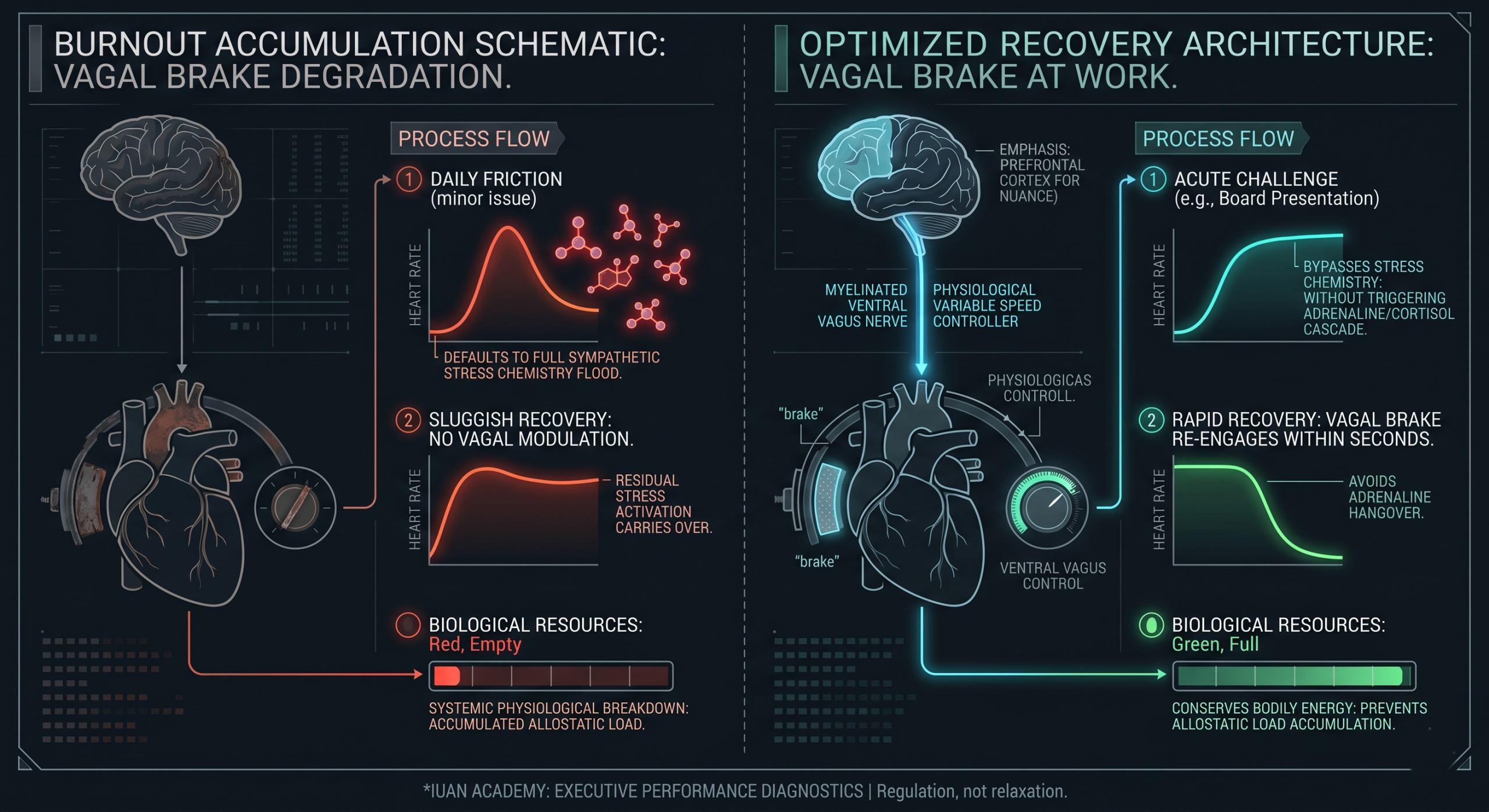
Diagram Left Section: Vagal Brake Degradation & Burnout Accumulation. This schematic visualises how a sluggish brake fails to modulate minor daily friction, leading to a flood of full sympathetic stress chemistry and a continuous adrenaline hangover.
Diagram Right Section: Vagal Brake active & Optimised Recovery Architecture. This system diagram illustrates how the myelinated ventral vagus acts as a precise physiological variable-speed controller. It demonstrates how it momentarily releases to accelerate heart rate for acute challenges like board presentations without triggering cortisol and adrenaline secretion, and then re-engages for rapid, smooth recovery to conserve biological resources and prevent allostatic load.
The vagal brake prevents professional burnout by acting as a highly precise, built-in regulator that allows your nervous system to respond to challenges without depleting your biological resources. Controlled by the myelinated ventral vagus nerve, the vagal brake acts like a physiological variable-speed controller for your heart rate.
Here is how it protects your system from burning out:
- It Bypasses Stress Chemistry: When you face a demanding professional moment such as a board presentation, a negotiation, or a difficult conversation, the vagal brake momentarily releases. This allows your heart’s natural pacemaker to rapidly increase your heart rate so you can meet the challenge, but it does so without triggering a full sympathetic stress response. This means you can remain sharp and engaged without your body secreting the cortisol and adrenaline that drive chronic stress.
- It Enables Rapid Recovery: The difference between a regulated nervous system and a reactive one is how cleanly it recovers. A well-functioning vagal brake re-engages within seconds after an acute stressor has passed, rapidly returning your heart rate to its resting baseline. This allows you to avoid an “adrenaline hangover” and prevents residual stress activation from carrying over into your next task or meeting.
- It Conserves Biological Resources: By allowing you to navigate daily professional challenges without constantly flooding your system with stress hormones, the vagal brake conserves vital bodily energy that would otherwise be spent on an unnecessary survival response. This prevents the accumulation of “allostatic load” the massive biological wear-and-tear that physically causes the symptoms of burnout.
When professionals operate under sustained pressure without adequate recovery, the vagal brake gradually degrades, becoming sluggish and less precise. As this happens, your resting heart rate creeps upward, your body takes much longer to recover from activation, and your nervous system begins to default to full sympathetic stress chemistry even for minor, everyday frictions. This loss of the vagal brake’s protective modulation is what ultimately traps individuals in a state of chronic hyperarousal, leading to systemic physiological breakdown.
© 2026 iuan · iuan Academy | iuan.com.au